
Why your credit card is missing from your finance app

Co-founder of Penge · Published 12 August 2026 · 8 min read
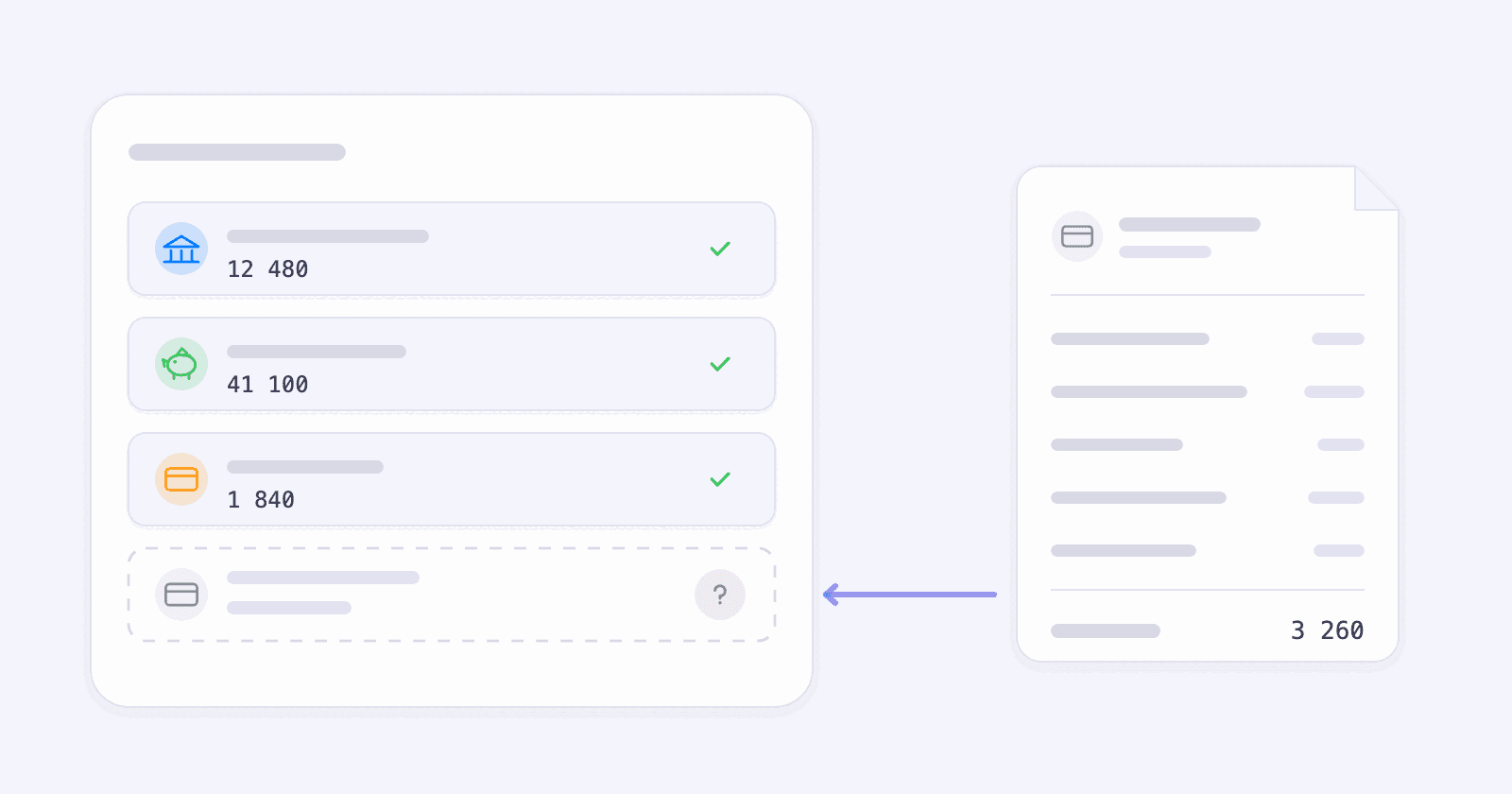
You connect your bank, everything arrives, and then the credit card is missing. The reason sits in the rules rather than in the app, and it helps to know it before you give up.
Key takeaways
- PSD2 applies to payment accounts. A credit card counts as one when the account is available online and can send and receive payments to and from third parties, and the Norwegian regulator holds that a number of credit cards have those characteristics.
- Some card issuers are reachable through Open Banking and some are not, and it changes without notice.
- Check the issuer in the bank search rather than guessing. The list is by issuer rather than by card, so the final test is to connect and see which accounts appear.
- If your card is not there, upload the statement as PDF, CSV or Excel and the transactions come in anyway.
- A shared credit card can be split by tagging each purchase with the person it belongs to.
Why is the card missing?
PSD2 gives you the right to share your payment accounts. Whether your credit card counts as one depends on what the account can do: if it is available online and can send and receive payments to and from third parties, the Norwegian regulator says it should be available. Many credit cards are.
Finanstilsynet cites the EBA statement that credit card accounts which are accessible online and can send and receive payment transactions to and from a third party shall be made available to account information providers, and adds that a number of credit cards have those characteristics.[2] What decides it is what the account can do, not what the product is called.
In practice the picture is still uneven. Some cards are plain credit facilities without the payment-account functions, and fall outside. Others should be available, but the issuer has not built the interface, or it works badly. Then there is no connection to choose, whichever app you use, and it is not something an individual app can solve by trying harder.
How to check your card
Search for the issuer in the bank search. It is the same list the app connects to, so if the issuer is there, there is a connection to try. The list is by issuer rather than by individual card, so the final test is to connect and see which accounts appear.
A list of which cards work would be out of date the moment it was published. Issuers come and go, and the search shows what is true now.
See which banks and card issuers are supported: Search the bank list
If the card cannot be connected
Upload the statement as a file. Penge reads the transactions straight from PDF, CSV or Excel, and they land in the same overview as the connected accounts, with the same categorization.
That is manual once a month instead of automatic, but it is the same overview. For a card you use a lot the two minutes pay for themselves, because without it you are usually missing the spending that is hardest to remember.
Is this going to change?
The rules are being revised, but the part being adopted now does not extend Open Banking to credit cards. PSD3 and the Payment Services Regulation keep the data access right tied to payment accounts. A separate regulation, FIDA, would cover credit agreements, and it is still stuck in negotiation.
PSD2 is being replaced by PSD3 and a new Payment Services Regulation. Parliament and Council reached political agreement on 27 November 2025, and Parliament's economic affairs committee approved the text on 5 May 2026. Formal adoption and publication in the Official Journal are still to come, expected in the second half of 2026. The regulation enters into force 20 days after publication and applies 21 months after that, realistically in 2028.[1]
That package tightens how access works: the quality of the interfaces banks have to provide, fraud handling and liability. It does not move the boundary of what is covered. Your credit card does not become available because PSD3 is adopted.
The regulation that would close the rest is FIDA, the EU framework for financial data access. It extends mandatory sharing to credit agreements, loans and accounts other than payment accounts, which is exactly the card accounts PSD2 does not reach, as well as savings, investments, pensions and non-life insurance.[3]
FIDA has moved slowly. The Commission proposed it in June 2023, the Council agreed its position on 4 December 2024 and Parliament renewed its mandate the same month, and negotiations have run since without agreement. The scope is itself one of the disputed points. The proposal came close to being dropped from the Commission's work programme and survived as a pending file. If it is adopted, a phase-in period follows.
In short: there is a route to credit cards being covered, but it is nowhere near finished, and nothing being adopted now changes the situation for your card this year or next.
The shared card
If the two of you share one card, the bill arrives as a single number with the purchases mixed together. Tag each purchase with the person it belongs to and the total each of you owes falls out of the tagging. Anything genuinely shared can be tagged as such and counted at the share you set.
Get a full overview with Penge
Connect your bank and let the app categorize and budget automatically.
Frequently asked questions
- Why can I not connect my credit card?
- It depends on what the card account can do. If it is available online and can send and receive payments to and from third parties, the regulator holds that it should be available. If it is a plain credit facility, it falls outside. In practice some cards are still missing because the issuer has not built the interface.
- How do I know whether my card is supported?
- Search for the issuer in the bank list, which is the same list the app connects to. It is by issuer rather than by individual card, so the certain answer comes from connecting and seeing which accounts arrive. A list inside an article would go out of date immediately.
- What do I do if my card is not supported?
- Upload the statement as PDF, CSV or Excel. The transactions are read straight from the file and land in the same overview as the connected accounts, with the same categorization.
- Can two people share one credit card in the app?
- Yes. Tag each purchase with the person it belongs to and you see the total each of you owes without going through the bill line by line. Anything shared can be tagged as such and counted at the share you set.