
EuroBonus card picker
Answer six questions and see which EuroBonus card is cheapest for the trip you want.
Six answers
Not important
Fine tuning
We set these for you. Change any of them if you know your own.
Everything is worked out in your browser. No data leaves your device.
Your two cards
Get the SAS EuroBonus Mastercard and the Trumf Kredittkort.
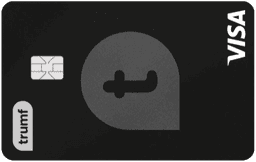 Trumf Kredittkort at Meny, Kiwi, Spar and Joker
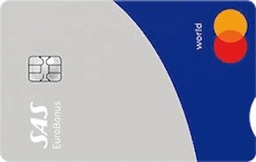 SAS EuroBonus Mastercard everywhere else
Counted without campaigns. Bonus offers, point sales and transfers can bring the seat closer, so the time is a rough ceiling.
- The seat:
- an economy return inside Europe
- Points you need:
- 30,000
- Wait:
- 2 years
- Point value:
- NOK 0.10
Why this set
- Two cards beat one here. The Trumf Kredittkort pays more at Meny, Kiwi, Spar and Joker, so that spending goes on it.
Worth knowing
- The first year gives 22,445 points and costs NOK 300. That is the first year only.
- The DNB SAGA + EuroBonus is left out of the answer, because the bank asks for NOK 1,000,000 a year. It is still in the table below.
What changes the answer?
What you put on the card
Share on American Express
- For an economy return to the US or Asia the answer changes to DNB Mastercard + EuroBonus and Trumf Kredittkort.
Set both numbers from your own spending. The answer hangs on them. Tap a row to try it.
Compare with your own set
Price against points
Every card, ranked
- SAS EuroBonus Mastercard
- Points a year
- 20,160
- Price a year
- NOK 588
- Time to seat
- about 1.5 years
- Gain a year
- NOK 1,428
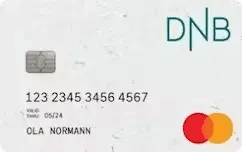 DNB Mastercard + EuroBonus
- Points a year
- 19,200
- Price a year
- NOK 708
- Time to seat
- about 1.5 years
- Gain a year
- NOK 1,362
 SAS EuroBonus Lunar
- Points a year
- 16,512
- Price a year
- NOK 588
- Time to seat
- about 1.5 years
- Gain a year
- NOK 1,213
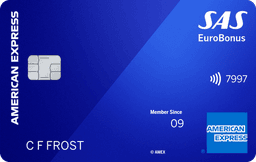 SAS Amex Classic
- Points a year
- 9,600
- Price a year
- NOK 360
- Time to seat
- about 3 years
- Gain a year
- NOK 600
- Trumf Kredittkort
- Points a year
- 3,629
- Price a year
- NOK 0
- Time to seat
- about 8 years
- Gain a year
- NOK 363
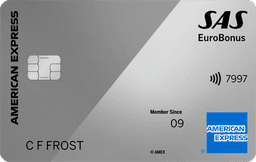 SAS Amex Premium
- Points a year
- 14,400
- Price a year
- NOK 1,800
- Time to seat
- about 2 years
- Gain a year
- -NOK 110
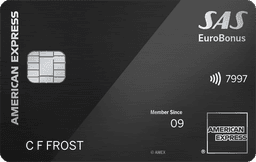
 SAS EuroBonus Mastercard Premium
- Points a year
- 29,760
- Price a year
- NOK 3,348
- Time to seat
- about 1 year
- Gain a year
- -NOK 372
 SAS Amex Elite
- Points a year
- 19,200
- Price a year
- NOK 6,900
- Time to seat
- about 1.5 years
- Gain a year
- -NOK 4,980
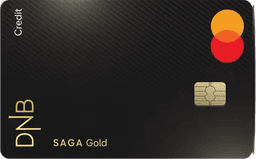 DNB SAGA + EuroBonus
NOK 1,000,000 a year, your salary paid in there
- Points a year
- 28,800
- Price a year
- NOK 2,028
- Time to seat
- about 1 year
- Gain a year
- NOK 1,352
What we assumed
Numbers we set for you6 notes
- Spending figures
- The figures behind the choices at the top are SSB's consumption survey for 2022 by household type, less housing, car purchases and insurance, which do not go on a card. The student is our own guess: Lånekassen pays about 15 000 kr a month, and rent takes about half.
- The wait
- The wait for a trip is two years inside Europe, three for a long trip or a business seat, four for a long business trip. Those waits are our own rough figures, so a set that needs up to three months longer still counts as in time. The wait only separates two sets that gain you about the same, so it never costs you money. Set your own under Fine tuning.
- What a point is worth
- We count a point as NOK 0.10, what an award trip saves you against paying for the ticket. The card with the largest gain a year wins, with a 2 for 1 voucher counted as the points it saves. Set your own figure under Fine tuning.
- The Amex share
- Nobody publishes how much of a Norwegian's spending can be paid with American Express, so the share above is a guess you should change. Spending that cannot go on the card earns nothing here.
- The Trumf bonus
- With Trumf Kredittkort and Trumf Pay you get 3% Trumf bonus at Meny, Kiwi, Spar, Joker and the other NorgesGruppen shops. 1% of that comes from scanning Trumf, card or not, so we credit the card with 2%. That bonus reaches EuroBonus at 13.5 points a krone on a scheduled transfer, or 10 on a one-off, so 27 points per 100 kr on a scheduled transfer. Both rates are on trumf.no. The card pays nothing outside those shops, so we count 7% of your spending there. The share is our own: food is about 12% of what a Norwegian household spends, and NorgesGruppen holds about 43% of the grocery market. Change it under Fine tuning.
- The SAS share
- 5% of your spending goes on SAS tickets, where some cards pay a higher rate. The rest earns the ordinary rate. Set your own under Fine tuning.
How we count13 notes
- Sets of cards
- We try every card on its own and every mix of them, with at most four cards that have a yearly price. A card with no yearly price can always join, as long as it takes some of the spending or earns level points. Each krone goes to the card that pays most for it, and you pay every yearly price. Sets within 500 kr a year of each other count as equal, and then the set that reaches the seat inside your wait wins, and after that the fewest cards you pay for. A set that leaves you the same money and reaches the seat sooner comes first.
- What we do not price
- Travel insurance, lounge access and a seat upgrade are listed for each card in the table, but they are not counted in the gain. What they are worth depends on what you already have: most people here are insured through their home insurance or their job, and a figure we made up would decide the answer for you. Weigh them yourself against the price a year. The surcharge on spending in another currency is left out too, since we do not ask how much of your money goes abroad.
- The prices
- We use the newest price for each card. Where a rise is announced, we use the new price, since that is what you will pay. Check the bank's own page before you apply.
- The price of a seat
- A seat costs what the SAS points table lists one way, times two for the return. Award seats are limited, and partner airlines are priced separately.
- Welcome bonus
- A welcome bonus counts once, and only when your spending reaches what the bank asks for. Banks pay it to new customers, so it is worth nothing on a card you already hold.
- Earn caps
- Some cards stop giving points above a yearly spending limit, and we stop counting there too.
- The 2 for 1 voucher
- A 2 for 1 voucher halves the points price: two people fly for one seat, or one person for half a seat. It only works on award flights SAS has marked for it, shown with a yellow dot in the booking search. Each voucher asks for its own round of spending in a calendar year, and taxes and charges come on top. The SAS Amex Classic voucher works only inside Europe, and only the SAS Amex Elite voucher works in business. We halve as many trips as the card has vouchers, up to the trips a year you entered.
- The DNB SAGA requirement
- DNB SAGA asks for both an income and your salary paid in there. There are other ways in that we do not check, so read the requirement as a minimum.
- Trumf Pay
- We count you as paying with Trumf Pay in those shops. Without Trumf Pay the card gives 2% instead of 3%, and since 1% comes anyway, what the card adds is halved.
- A second card
- Some banks have no add-on card. At DNB the partner takes their own card at full price, so two people pay twice. Where a bank publishes no price at all, we count the second card as free and mark it.
- Level points
- Level points count toward Silver and Gold: Silver takes 20 000 inside twelve months and Gold 45 000, or 10 and 45 one-way SAS flights. SAS Amex Elite gives 6 level points per 100 kr, SAS EuroBonus Mastercard Premium a quarter of its points, and DNB SAGA 10 000 at 100 000, 200 000 and 500 000 kr a year. Ordinary points do not count. We price level points at zero, because what a status is worth is yours to say.
- Level points from flying
- Flying is the main source of level points for most people. EuroBonus ChangeMakers pays 5 000 level points a year for ten actions, and SAS sells the last 5 000 toward Silver and 15 000 toward Gold once you have earned the rest. Neither is in the figures.
- Campaigns
- We count no campaigns. Trumf bonuses such as 50 % at Meny or 15 % on fruit and vegetables come on top, and lift every set with a Trumf card about the same. So the figures here are the least you get.
For guidance only. This is an estimate, not financial advice.
See where the spending behind the points goes
Penge gathers your accounts and cards in one place, so you can see what you actually spend before you chase the next point.
Which EuroBonus card is cheapest for you?
Every EuroBonus card costs money to hold and gives points at its own rate, so the cheapest card and the fastest card are rarely the same one. This page asks what you spend, where you want to fly and which seat you want. It then works out for every card what it earns in a year, what it costs in a year and how long it takes you to reach that seat. The card with the largest gain a year wins: the points it earns, less what it costs. Only when two cards gain you about the same does the wait decide, and then the one that gets you there inside a sensible wait wins. So a cheap card can beat a dearer one that earns faster.
Where your own answer will differ
- The seat prices come from the SAS points table for one way, doubled for the return. Award seats are limited, so the seat you want is not always on sale at that price.
- A welcome bonus counts once. It can decide a short trip and hardly matters for a long one, which is why the winner changes when you change the seat.
- American Express is refused in more places than Mastercard, and nobody publishes how much of a Norwegian's spending can be paid with it. The share you set decides how much an Amex card earns here, so set it from where you really shop.
- The card is only cheap if you clear it every month. Interest on a card balance costs far more than any point is worth.
- Level points are not bonus points, and they only count for twelve months. The Mastercard Premium pays its 500 a month in the months you use the card, so a card left in the drawer pays none.