
How to build a budget that actually sticks

Co-founder of Penge · Published 5 May 2026 · 7 min read
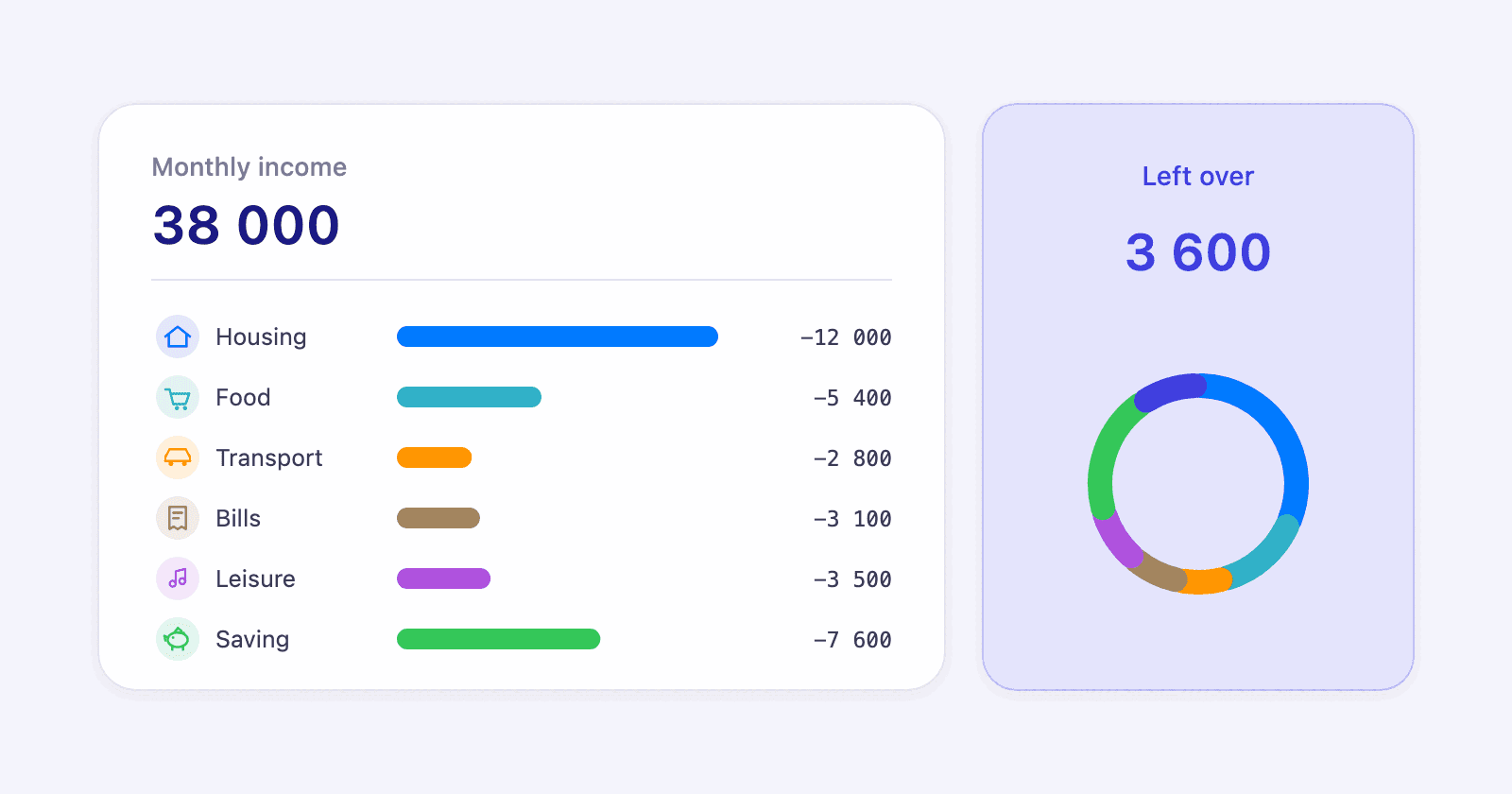
A budget sounds boring until you see what it does to your savings account. Here is a simple method you can set up in fifteen minutes, and actually keep to.
Key takeaways
- A budget is a plan for your money, not a punishment: it directs your money toward what matters instead of small, forgotten purchases.
- Build it in four steps: work out your net income, map your spending, split it with the 50/30/20 rule, and automate saving.
- The 50/30/20 rule puts 50% of net income toward needs, 30% toward wants, and 20% toward savings and paying down debt.
- Save first: set up a fixed transfer on payday and live on what is left.
- The most common mistakes are budgeting too tightly, forgetting irregular yearly costs, and never following up.
Why make a budget?
A budget is a plan for how you want to use your money, so it goes toward what matters to you instead of disappearing into small purchases you do not remember. The goal is not to count every krone forever, but to understand your pattern well enough to make better choices.
A budget is a plan for how you want to use your money, so it goes toward what matters to you instead of disappearing into small purchases you do not remember. Most people underestimate how much they spend on subscriptions, food and impulse buys, simply because no one is keeping track.
The point is to understand your pattern well enough to make better choices, and then let the system run on its own. Nobody needs to count every krone for the rest of their life.
Step 1: Work out what you actually earn
Start with your net income, the amount that lands in your account after tax. If your income varies, use a cautious average of the last three to six months. It is better to budget low and be pleasantly surprised than the other way around.
Step 2: Map out your spending
Go through the last two or three months and split your spending into two groups:
- Fixed costs: rent or mortgage, electricity, insurance, phone, childcare, subscriptions.
- Variable costs: food, transport, clothes, going out, shopping, the things that change from month to month.
This is the step where most people get a surprise. Look especially for subscriptions you have forgotten you pay for, and how much food and eating out actually add up to together.
Step 3: Use the 50/30/20 rule
A simple and proven split is to divide your net income into three parts:
- 50% for needs: what you have to pay to live, such as housing, food and bills.
- 30% for wants: the things that make life enjoyable, such as travel, going out and hobbies.
- 20% for savings and paying down debt.
| Part | Share of net income | What it covers |
|---|---|---|
| Needs | 50% | Housing, food and bills |
| Wants | 30% | Travel, going out, hobbies |
| Savings and debt | 20% | Saving and paying down debt |
The percentages are a guide, not a rule. If you live somewhere expensive, needs quickly become more than 50%, and then wants or savings have to give a little. The point is to have a conscious relationship with the split rather than hoping it works out.
Budget calculatorSplit your income with the simple 50/30/20 rule.Step 4: Make saving automatic
The easiest way to save is to not have to decide every month. Set up a fixed transfer to a separate savings account on the same day your salary arrives. That way you save first and live on what is left, instead of saving whatever happens to be left over.
The most common mistakes
- Too tight a budget: set it far too low and you give up after two weeks. Leave a little room.
- Forgetting irregular costs: insurance, car service and Christmas presents come every year. Divide them by twelve and set aside a bit each month.
- Not following up: a budget you make once and never look at again is wasted. Check it a couple of times a month.
How Penge makes it easy
Doing this by hand works, but it quickly becomes a lot of effort. Penge connects to your bank accounts, suggests categories and sorts your transactions automatically when it is sure, and shows you where your money actually goes, without any manual entry. You set a budget per category and see straight away whether you are on track to stay within it.
Want to know if Penge connects to your bank? See which banks are supported
Get a full overview with Penge
Connect your bank and let the app categorize and budget automatically.
Frequently asked questions
- How much should I save each month?
- A common rule of thumb is 20% of your net income, but the most important thing is to start with an amount you can keep up every month. Even a small, steady amount is better than none.
- What is the 50/30/20 rule?
- It is a simple budgeting method where you spend 50% of your net income on needs, 30% on wants, and 20% on savings and paying down debt.
- Do I need an app to make a budget?
- No, you can make a budget in a spreadsheet or on paper. But an app that connects to your bank and categorizes your spending automatically saves a lot of manual work and helps you actually keep track over time.