
Budgeting app for couples: what to look for

Co-founder of Penge · Published 29 August 2026 · 6 min read
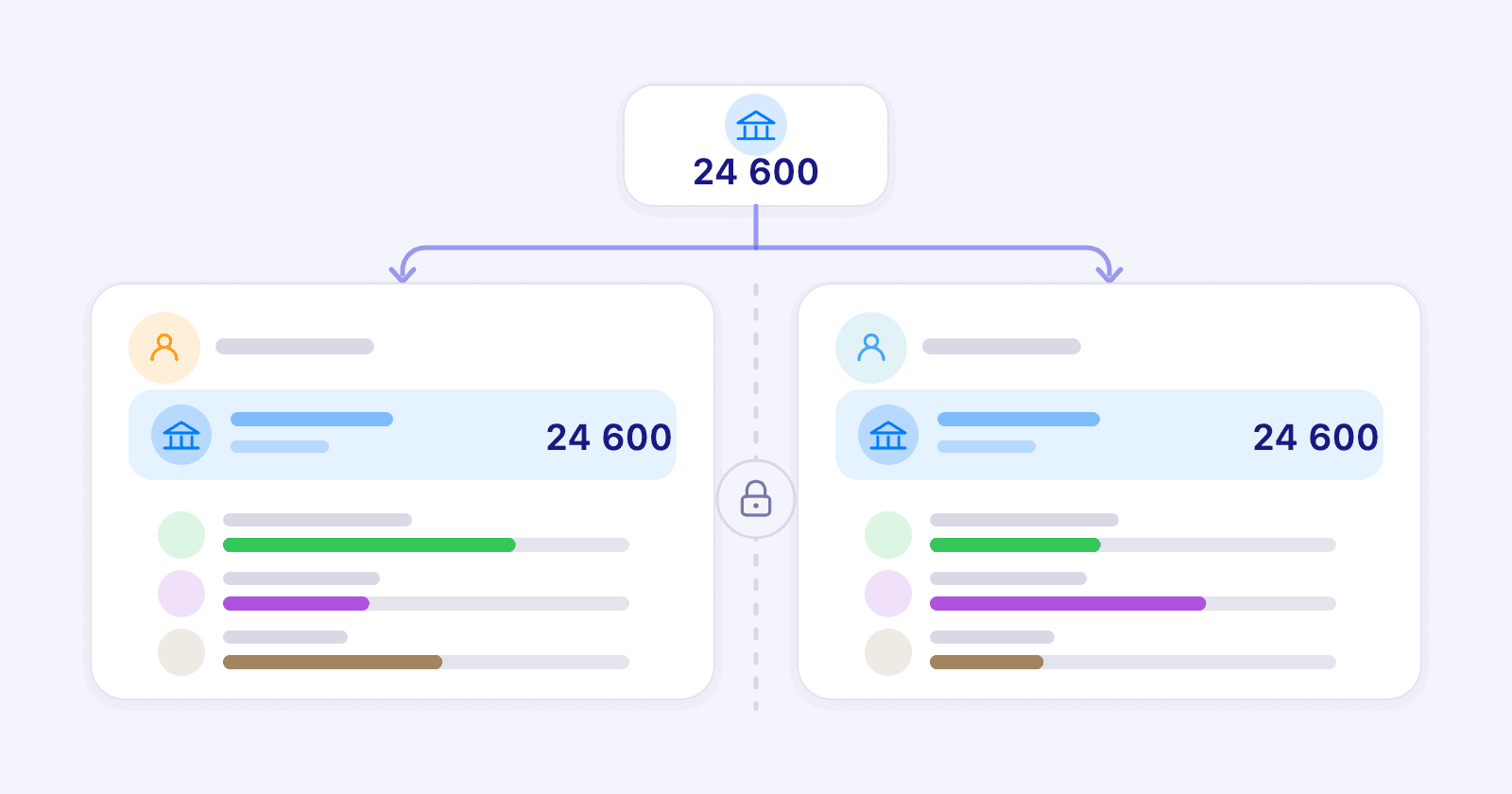
A joint account, two salaries and personal spending create a simple question: who needs to see which accounts? Penge currently gives each user a private overview. It does not combine two profiles or give one user access to another user's accounts.
Key takeaways
- Decide whether your finances are fully joint, fully separate or a hybrid before you compare apps.
- Penge does not currently let one user share a bank account with another Penge profile. Only the owner sees their banks, accounts and transactions.
- Budgets belong to the user who created them. Penge is not a joint household workspace.
- A transaction split in Penge divides an amount across categories, not people. Penge does not calculate who owes whom.
- Penge runs on iPhone.
Which model do you actually use?
Most couples run one of three models: fully joint, fully separate or a hybrid. Fully joint means one pot for income and expenses. Fully separate means each person manages their own accounts and agrees how to divide household bills. A hybrid uses joint accounts for shared costs and personal accounts for the rest. Each model needs different app permissions.
| Model | The hard part | What the app has to do |
|---|---|---|
| Fully joint | Giving both people access without one shared login | Provide a genuine household or account-sharing feature |
| Fully separate | Keeping each person's accounts private | Give each person a separate user space |
| Hybrid | Showing joint accounts without exposing personal ones | Offer selective sharing with clear permissions |
We have written about choosing a setup in managing money as a couple. Penge supports separate user spaces, but it does not currently provide the selective account sharing required by the joint and hybrid rows above.
Five things worth checking
- Can each person use their own login? A shared login removes the boundary between personal and household data. Penge accounts are individual.
- What exactly is shared, and can the owner revoke access alone? Check accounts, balances, transactions and budgets separately. Penge currently shares none of these between user profiles, so it has no sharing permission to revoke.
- Are budgets joint or personal? In Penge, every budget belongs to one user. A second profile cannot see or edit it.
- Does splitting a transaction mean categories or people? In Penge it means categories. There is no person field, debt balance or settle-up flow.
- Does it run on both of your devices? Penge runs on iPhone.
Can two people share an account in Penge?
No. Every bank, bank account, transaction and budget in Penge is visible only to the user who owns it. Another Penge user cannot receive a chosen account, its balance or its transactions. There is therefore no sharing permission for the owner to revoke, and neither user can see the other's private data.
If one person connects the household accounts, those accounts remain in that person's Penge profile. The other person sees none of them in their own profile. The direction does not reverse either: connecting your accounts never exposes anything from the other person's profile to you.
How should you handle a reimbursement?
Suppose you pay 18,000 kroner in rent and your partner sends you 9,000. Penge stores those as two transactions in your account. You can give both the housing category so the incoming payment offsets part of the outgoing amount in that category. Penge does not attach either transaction to a person or record a debt between you.
The Split transaction feature solves a different problem. It divides one payment into amounts with their own categories, such as groceries and household goods on one receipt. Each part has an amount, currency and category. It has no person field and cannot calculate or settle what one person owes another.
Where Penge still helps a couple
If you are both account holders of the joint account, each of you can connect it from your own bank login, provided your bank returns it after approval. You then each see the same joint account live in your own private profile, with nothing shared between the profiles.
Each person can gather their own accounts, categorize household costs and create weekly, monthly or yearly budgets with live progress. That can make individual contributions easier to understand, but the two overviews and budgets stay separate.
An app also cannot decide whether your arrangement is fair or whether a ski trip is a household expense. Agree on those rules first, then choose software that supports the access you actually need.
Budget calculatorSplit your income with the simple 50/30/20 rule.Get a full overview with Penge
Connect your bank and let the app categorize and budget automatically.
Frequently asked questions
- Can two people use one Penge account?
- No. Each person has their own Penge user profile, and the current implementation does not share banks, accounts, transactions or budgets between profiles.
- Should we use a joint account or keep everything separate?
- For most couples a hybrid works best: a joint account for rent, groceries and other fixed shared costs, personal accounts for the rest. If both of you need the same in-app view of the joint account, note that Penge does not currently provide that shared view.
- How do we handle different incomes?
- Agree on a fixed amount or a proportion outside the app. Penge can show the transactions and category totals in each user's own profile, but it does not coordinate contributions between two people.
- What happens to shared data if we split up?
- Penge currently has no shared data between user profiles and therefore no account-sharing access to revoke. Each person keeps the data in their own profile.