
The 15-minute monthly money review

Co-founder of Penge · Published 28 August 2026 · 5 min read
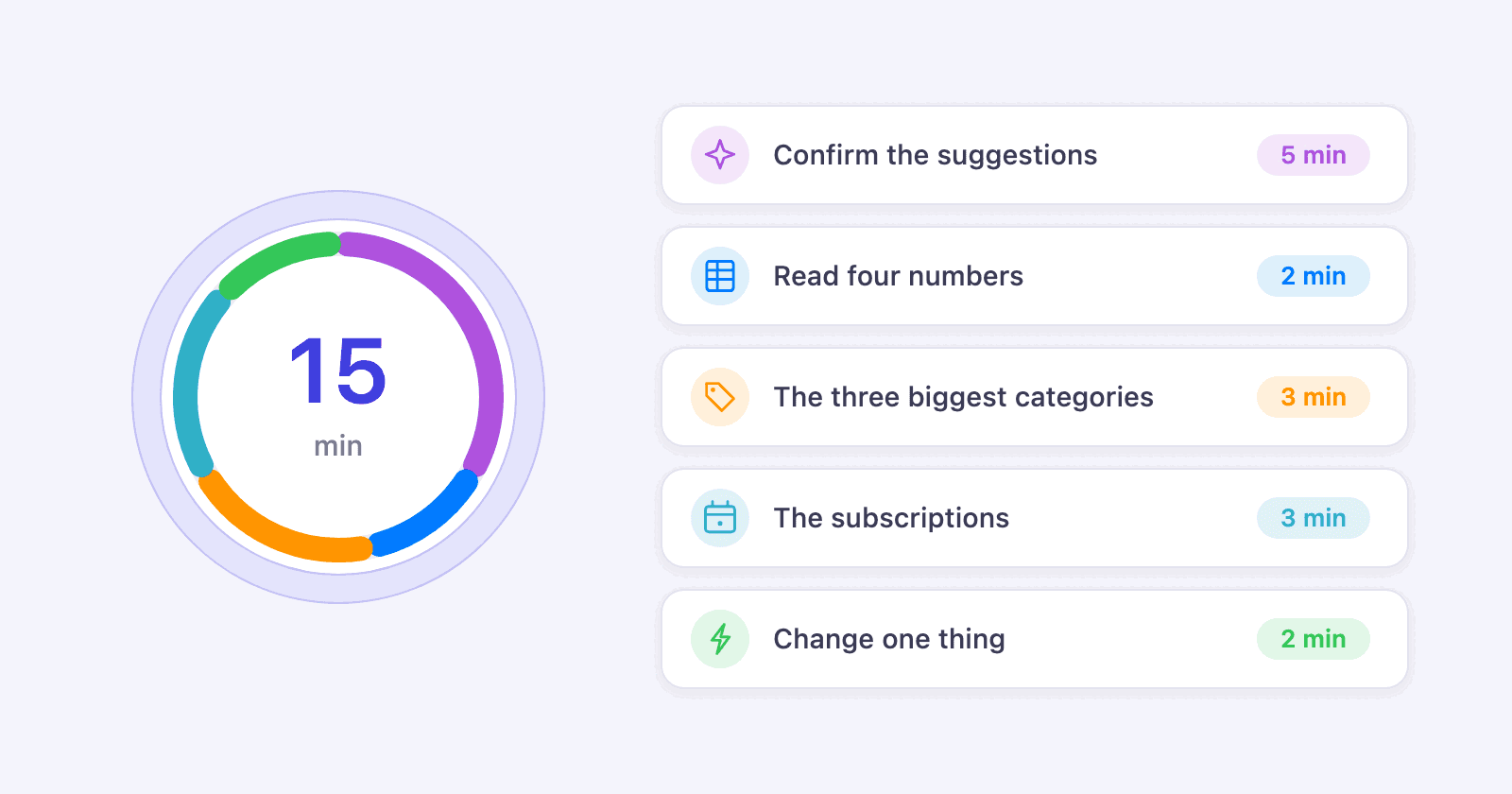
You do not need an hour with your finances every month. You need fifteen minutes, the same fifteen minutes every month, and a list short enough that you actually get to the end of it.
Key takeaways
- Do it two or three days after your usual payday, when the salary and the first fixed bills are visible.
- Five steps: confirm category suggestions, read four numbers and your spending pace, compare your biggest categories, review subscriptions, change one thing.
- Changing one thing per month is the part that compounds. Reading numbers without acting is just a habit that feels productive.
- Do not rebuild the budget and do not audit the whole year. Neither fits in fifteen minutes, and both crowd out the short review.
When should you do it?
Two or three days after your usual payday, once the salary and the first fixed bills are visible. This gives you a current picture while leaving time to shape the rest of the month. Use your own pay cycle rather than the first day of the calendar month.
Put it in the calendar as a repeating appointment. Not because it takes discipline, but because a decision you have already made does not have to be made again.
Step 1: confirm the suggestions (5 minutes)
Open the transactions without a category. Every transaction arrives with a category suggested from your own history, and you confirm it with one tap. Penge can remind you when transactions still need a category, and a widget lets you categorize without opening the app. Turn on automatic categorization in settings and Penge applies the most confident suggestions itself, never overwriting a category you set.
Step 2: read four numbers (2 minutes)
Read them for the pay period that just ended. The buffer itself has its own guide.
- What came in.
- What went out.
- The difference between them.
- Whether you touched the buffer.
Then glance at your spending pace day by day. The four numbers show the result so far, while the pace shows whether spending has accelerated or settled down recently.
Step 3: your three biggest categories (3 minutes)
Keep the short review focused on the three categories where you spent the most. Compare each with its budget, then compare the period with your average month. Ask one question: was this a one-off, or is it what the category usually costs now?
If it is what it costs now, the budget is wrong rather than you. Fix the number.
Step 4: the subscriptions (3 minutes)
Review the subscriptions you track. Compare the typical charge and last charge date with the matched payments. Look for an amount that changed, a payment that does not belong, or a subscription you no longer need.
Penge detects repeating expenses in your transaction history. For a tracked subscription it links matching charges and keeps the typical charge amount, billing interval and last charge date up to date. The iPhone app uses those values to estimate monthly cost and calculate the next expected charge date. There is more in getting control of your subscriptions.
Step 5: change one thing (2 minutes)
Pick one action from what you found and do it now, in the two minutes you have left:
- Raise the one budget that is wrong every single month.
- Cancel one subscription.
- In your bank, set a fixed transfer to savings for payday.
- Pay a bit extra off the most expensive debt you have.
One change a month is twelve a year. Twelve reviews with no changes is a habit that feels like progress and is not.
What not to do in fifteen minutes
- Do not rebuild the category structure. That is a job for once a year, if ever.
- Do not go through the whole year. It turns a short review into a backlog instead of helping with a decision today.
- Do not open the pension and the mortgage at the same time. Give each a separate session when it needs attention.
Get a full overview with Penge
Connect your bank and let the app categorize and budget automatically.
Frequently asked questions
- Is once a month often enough?
- For the review, yes. Day to day you can glance at a budget when you are about to spend. The monthly sitting is for making decisions, and those do not need to be revisited every week.
- What if I am behind by several months?
- Do the most recent full month only and let the older ones go. Catching up turns a short review into a backlog, and the old months cannot be changed anyway.
- Should we do this together as a couple?
- Yes, if the decisions affect you both, and keep it just as short. An agenda gives each of you the same questions and a clear end to the review.
- What if the numbers are bad?
- Then the review did its job. A bad month you know about is manageable, and step five exists precisely so you leave with one thing changed rather than one thing to worry about.