
Norway's policy rate up to 4.5%: what the September 2026 rise costs you per month

Co-founder of Penge · Published 24 September 2026 · 6 min read
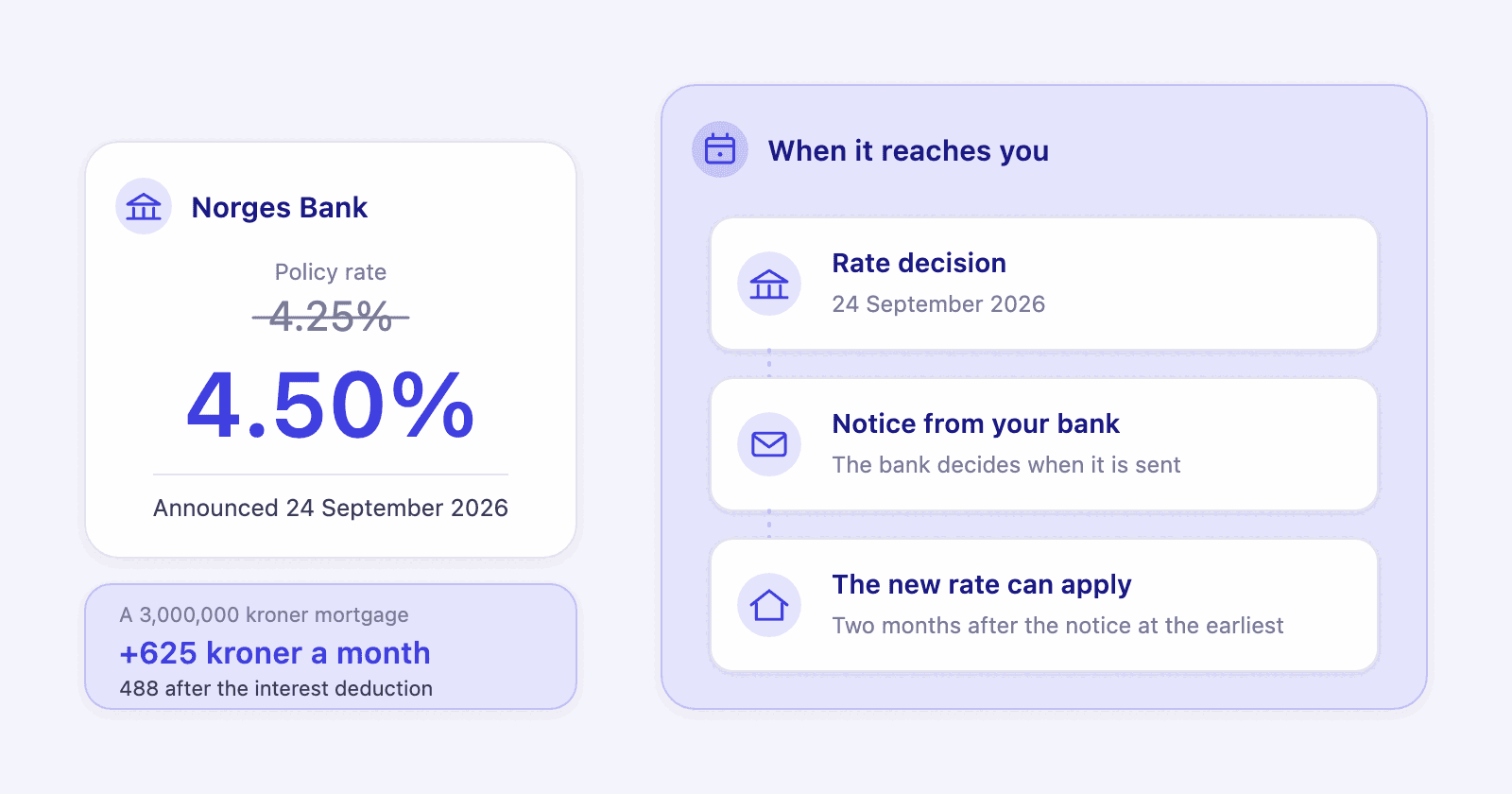
Norges Bank raised the policy rate by 0.25 percentage points today. On a 3,000,000 kroner mortgage that is 625 kroner more in interest a month, around 488 kroner after the interest deduction. It does not leave your account yet: your bank has to send you a notice first, and a rise cannot take effect until two months after that notice.
Key takeaways
- Norges Bank raised the policy rate from 4.25% to 4.50% at its meeting on 23 September, announced on 24 September 2026. The next decision comes on 5 November 2026.
- 0.25 percentage points costs 2,500 kroner a year per million you owe: 208 kroner a month before the interest deduction and 163 kroner after. On 3,000,000 kroner it is 625 kroner before and 488 after.
- Your monthly payment rises by less than your interest does. On a 3,000,000 kroner annuity loan with 25 years left the payment goes up by around 444 kroner while the interest goes up by 625. The gap is principal you no longer repay.
- Nothing changes today. A change to your disadvantage cannot take effect until two months after your bank has told you, so late November at the earliest, and December for many banks.
- Norges Bank projects the average residential mortgage rate rising from 5.2% in 2026 Q3 to 5.6% towards the end of 2027, before falling gradually.
How much more will my mortgage cost?
0.25 percentage points costs 2,500 kroner a year per million you owe. That is 208 kroner a month before the interest deduction and 163 kroner after. On 2,000,000 kroner it is 417 and 325 kroner, on 3,000,000 kroner it is 625 and 488. Work from the whole balance, not from the payment you make today.
The sum is small enough to do in your head. Take the outstanding balance, multiply by 0.0025, and divide by twelve. That number decides whether the news matters to you, and it is worth working out yourself rather than hunting for it in a newspaper.
| Loan | Extra interest per month | After the interest deduction | Rise in the monthly payment |
|---|---|---|---|
| 1,000,000 kroner | 208 kroner | 163 kroner | 148 kroner |
| 2,000,000 kroner | 417 kroner | 325 kroner | 296 kroner |
| 3,000,000 kroner | 625 kroner | 488 kroner | 444 kroner |
| 4,000,000 kroner | 833 kroner | 650 kroner | 592 kroner |
| 5,000,000 kroner | 1,042 kroner | 813 kroner | 740 kroner |
The third column is the interest deduction. The tax rate on general income is 22.0% in 2026, and the same rate is applied to deductions, so an interest cost ends up costing you 78% of itself.[6] In the Troms and Finnmark action zone the rate is 18.5%, and the deduction is worth correspondingly less.[6]
The fourth column is lower than the second, which surprises people. When the rate changes, the agreed term of an annuity loan is kept unless something else is agreed.[5] The payment is recalculated over the term you already have. On 3,000,000 kroner with 25 years left, the first month's interest goes from 13,000 to 13,625 kroner while the payment goes from 17,889 to 18,333. The missing 181 kroner is principal you no longer repay. The cost is real, but part of it arrives as slower repayment rather than as a bigger debit.
Loan calculatorWork out the monthly cost and total interest on your loan.When does the amount leaving my account change?
Not today. Your bank sets its own rate and has to tell you in writing first. A change of terms to your disadvantage cannot take effect until two months after that notice. If your bank sends the letter in late September, the new rate applies from late November at the earliest. If it takes a week or two to decide, you are into December.
The deadline is in the Norwegian Financial Contracts Act, section 3-13 second paragraph: a change of terms to the customer's disadvantage may take effect at the earliest two months after the customer has been told about the proposal. The third paragraph requires a proposal to change interest, fees or other costs to come with reasons.[4] If you find "six weeks" in older guidance, that was the deadline in the 1999 Act. It was replaced on 1 January 2023, and two months is the rule now.
| What happens | When | Who decides |
|---|---|---|
| Policy rate raised to 4.50% | 24 September 2026[1] | Norges Bank |
| Your bank announces its own increase | The days and weeks after | Your bank |
| Written notice reaches you | When the bank sends it | Your bank |
| The new rate can apply at the earliest | Two months after the notice[4] | The Financial Contracts Act |
| Next rate decision | 5 November 2026[2] | Norges Bank |
Three exceptions to that timeline
- On a fixed-rate loan nothing happens until the fixed period ends, and then you get whatever rate applies that day.
- If your rate follows a reference rate written into the loan agreement, the bank may change it at once and tell you afterwards. That is unusual on ordinary Norwegian mortgages, but read the agreement if you are unsure.
- A rate cut is not to your disadvantage, so it carries no two-month deadline. The rule runs one way only.
Will my bank raise my rate by exactly 0.25?
That is your bank's decision. The policy rate is what banks earn on their deposits at Norges Bank, not the rate on your loan, so 0.25 percentage points on the policy rate is not a promise of 0.25 on your mortgage. The number that applies to you is in the notice from your bank, together with the reasons for it.
Norges Bank itself assumes that more than this single step feeds through over the next year. In Monetary Policy Report 3/2026 the bank projects the residential mortgage rate rising from 5.2% in 2026 Q3 to 5.6% towards the end of 2027, before falling gradually.[3] That figure is the average rate on outstanding repayment loans secured on dwellings in Statistics Norway's monthly interest rate statistics, so it is a market average rather than an offer to you.
Further out the projection turns down again. Norges Bank expects an average residential mortgage rate just below 5% in 2029.[3] That is a forecast, not a promise, but it is a useful frame: plan for the rate staying near where it is for a while, not for it falling in the spring.
What does Norges Bank say about what comes next?
The Committee writes that it will likely be necessary to keep the policy rate elevated for a time, and that it is prepared to raise the rate further if warranted by the inflation outlook. In the forecasts the policy rate stays close to the current level for a period ahead before declining somewhat.
The rate path in the report is consistent with the rate increasing at this meeting and then remaining at 4.5% for a time. The forecast falls gradually from the end of next year to just below 3.5% towards the end of the projection period. On that path, inflation is projected to come down to the 2% target in 2029.[3]
The reason for the rise is inflation, not the housing market. The Committee points to inflation having been above target for several years, and to the rapid rise in business costs that will likely keep it elevated. In August, twelve-month CPI inflation was 3.3%, while the CPI-ATE, which excludes energy products and adjusts for tax changes, was 3.0%.[3] The Committee also flags that the rate may end up lower than the path shows if the summer's inflation figures turn out to be the start of faster disinflation.[1]
What should I do when the notice arrives?
Read the rate and the date, convert it into kroner on your own balance, and use the two months for something. The deadline is not just waiting time. It is the window in which you can ask for a better rate, get an offer from another bank, or decide where the money comes from in your budget.
- Find the new rate and the date it applies from. Both belong in the notice. If there is no date, there is no deadline you can plan against, and that is worth a phone call.
- Read the reasons. A proposal to change interest, fees or other costs has to be justified, and the justification tells you something about how much room there is to negotiate.
- Work the amount out on your own balance. Balance times 0.0025, divided by twelve. Do it for 1.00 percentage points too, so you know the range and not only the next step.
- Ask for a better rate, and get a second offer. Compare mortgage rates on Finansportalen before you call, so you know what you are asking for. The notice is the natural moment, because you have two months.
- If you need a lower payment rather than a lower rate, the term of an annuity loan can be extended by agreement when the rate goes up. As a consumer you can only make that agreement after you have received the notice. It makes the loan more expensive overall, but it is a real option.
- Decide where the money comes from. Either the emergency fund absorbs it for a few months, or one named category in the budget shrinks by exactly that amount. What a rate change costs you is the guide to rebuilding the budget after a rate change, in either direction.
- Check your savings rate at the same time. It only moves if your bank decides to pass the rise on, and the account your buffer sits in often pays less than the one next to it in the same bank.
How Penge helps
The hard step is the second to last one: knowing which category can take 488 kroner less. Penge pulls your transactions from more than 2300 banks and categorises them automatically when it is confident, so you can see where a whole year actually goes instead of guessing. Give interest and fees their own category and set a budget on it, and the next rate change becomes a line that has moved rather than a feeling that things are tighter. The app runs on iPhone, the bank connection is read-only, and your bank credentials are never stored.
Want to check whether your bank is supported? See which banks are supported
Get a full overview with Penge
Connect your bank and let the app categorize and budget automatically.
Sources
- Norges Bank: Policy rate raised to 4.50%, press release 24 September 2026
- Norges Bank: Policy rate, current level and next decision
- Norges Bank: Monetary Policy Report 3/2026, chapters 2 and 3 (PDF)
- Financial Contracts Act section 3-13 on changes to contract terms, Lovdata (Norwegian)
- Financial Contracts Act section 5-11 on the term of annuity loans, Lovdata (Norwegian)
- Norwegian Tax Administration: general income rates
Frequently asked questions
- What is Norway's policy rate now?
- The policy rate is 4.50%. Norges Bank raised it from 4.25% at its meeting on 23 September 2026, and announced the decision at 10:00 on 24 September. The rates apply from 25 September 2026. The next rate decision comes on 5 November 2026.
- What does 0.25 percentage points cost per month on a mortgage?
- 2,500 kroner a year per million you owe, so 208 kroner a month before the interest deduction and 163 kroner after. On 3,000,000 kroner it is 625 kroner before and 488 after. Multiply your outstanding balance by 0.0025 and divide by twelve for your own figure.
- How much notice must a Norwegian bank give before raising my rate?
- A change of terms to your disadvantage may take effect at the earliest two months after you have been told about the proposal. That is section 3-13 second paragraph of the Financial Contracts Act, and the proposal must also come with reasons. Older guidance saying six weeks is based on the 1999 Act, which was replaced on 1 January 2023.
- Why does my monthly payment rise by less than the interest?
- Because the term of an annuity loan is kept when the rate changes, unless you agree otherwise. The payment is recalculated over the term you already have, so part of the higher interest is covered by repaying less principal each month rather than by a bigger debit.
- Does the rise affect a fixed-rate mortgage?
- No, not while the rate is fixed. A fixed-rate loan keeps its rate until the fixed period ends, and then whatever rate applies at that point takes over. Only the floating part of your debt reacts to a change in the policy rate.