
What a change in the policy rate costs you each month

Co-founder of Penge · Updated 24 September 2026 · 6 min read
A rate decision makes the headlines, and then nothing visible happens to your account for weeks. Here is what actually moves, how much a change of a given size costs on your own loan, and what is worth working out before the next meeting.
Key takeaways
- The policy rate is not your loan rate. It is what banks earn on their deposits at the central bank, and it reaches you only through the rate your own bank decides to charge.
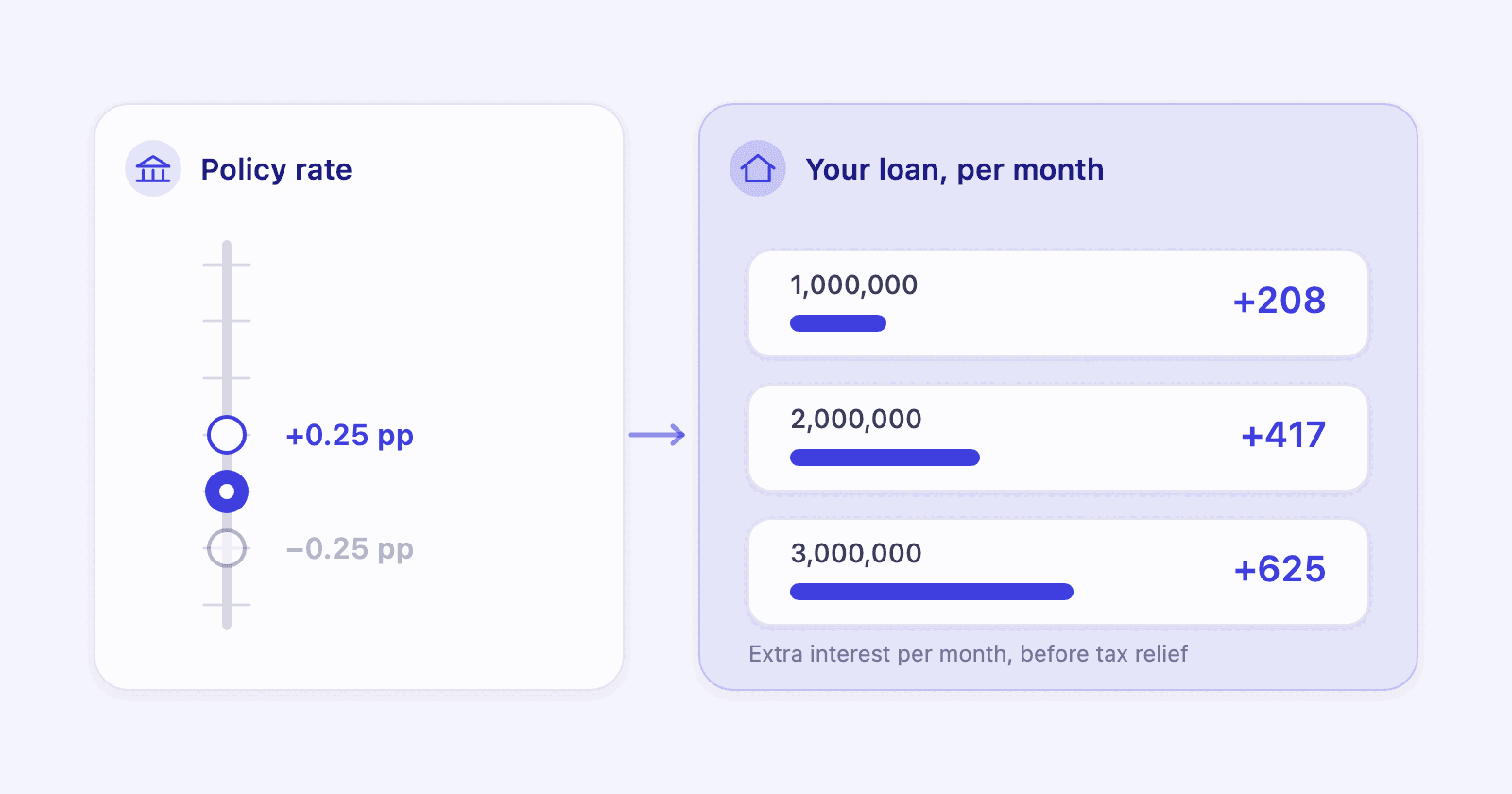
- The arithmetic is small enough to do in your head. A rise of 0.25 percentage points on a loan of 2,000,000 is 5,000 a year, which is about 417 a month before tax relief.
- Riksbanken left Sweden's policy rate unchanged at 1.75 per cent on 24 September 2026, applying from 30 September, and said rate rises are expected to begin this year if the outlook holds.
- Norges Bank raised Norway's policy rate from 4.25 to 4.50 per cent at its meeting on 23 September 2026, announced the next day, because inflation has been above target for several years.
- A fixed-rate loan does not move at all until its fixed period ends, and the rate on your savings moves too, usually in the same direction.
What does the policy rate do to my loan?
Nothing directly. The policy rate is what banks earn on deposits at the central bank. It sets the price at which banks lend to each other, and that shapes the rates they offer customers on mortgages and savings accounts. Your own bank still decides its own rate, and decides when to move it.
Norges Bank says it plainly: the policy rate applies only to banks' deposits in Norges Bank. Because banks find it cheapest to lend spare deposits to each other at that rate, the policy rate sets the price of interbank lending, and those rates in turn shape what banks charge customers on mortgages and pay on savings accounts.[3]
Riksbanken describes the same chain from the other end. A change in the policy rate first moves the overnight rate between banks, and expectations about future short rates then feed into longer market rates, which pushes on the rates banks and mortgage institutions set. Some of these mechanisms work on the economy fairly quickly and others take much longer.[4]
The practical version: the policy rate is a strong signal about where your loan rate is heading, not an instruction your bank has to follow. Banks compete, they fund themselves differently from one another, and they move at their own pace. A decision to hold rates still does not mean your bank will hold its own rate still, and a rise of 0.25 does not guarantee exactly 0.25 more on your loan.
How much does a rate change cost per month?
Multiply your loan by the size of the change, then divide by twelve. A rise of 0.25 percentage points on 2,000,000 is 5,000 a year, or about 417 a month before tax relief. The figure is the same in any currency, because it depends only on the size of the loan and the size of the change.
This is the one number worth working out for yourself, because it turns an abstract decision into a line in your budget. Take the whole of what you owe, not what you pay each month, and multiply by the change in percentage points.
| Loan | Rate up 0.25 pp | Rate up 0.50 pp | Rate up 1.00 pp |
|---|---|---|---|
| 1,000,000 | 208 | 417 | 833 |
| 2,000,000 | 417 | 833 | 1,667 |
| 3,000,000 | 625 | 1,250 | 2,500 |
| 4,000,000 | 833 | 1,667 | 3,333 |
| 5,000,000 | 1,042 | 2,083 | 4,167 |
Tax relief takes some of it back, at a rate your own tax authority sets. In Norway, general income is taxed at 22 per cent for 2026 and that same rate applies to deductions, so a rise costs you roughly 78 per cent of the figure above.[7] In Sweden, a deficit in the capital income category gives a tax reduction of 30 per cent up to 100,000 kronor and 21 per cent above that for income year 2026, so within the first bracket a rise costs roughly 70 per cent of the figure above.[8]
Loan calculatorWork out the monthly cost and total interest on your loan.When does the change actually reach my account?
Later than the decision, and only after your bank tells you. Consumer credit law in both Norway and Sweden requires notice before a rate increase takes effect, and a fixed-rate loan is not affected at all until its fixed period ends. Savings rates follow the same logic in the other direction.
| What | Who sets it | When it can change for you |
|---|---|---|
| Policy rate | The central bank | At its monetary policy meetings |
| Variable loan rate, Norway | Your bank | A change to your disadvantage takes effect at the earliest two months after the bank has told you about it[5] |
| Variable loan rate, Sweden | Your bank | At the end of the fixed period, which is at least three months, and the bank must tell you before it takes effect[6] |
| Fixed-rate loan | Nobody, until it rolls over | When the fixed period ends |
| Savings rate | Your bank | The bank moves this too, usually in the same direction as the loan rate |
Two details in that table are worth knowing about. In Norway, a change of terms to your disadvantage cannot take effect until at least two months after you have been told, and a proposal to change interest, fees or other costs has to come with reasons.[5] In Sweden, the lender has to apply a rate-change clause in your favour in the same way as against you, so the clause it uses to raise your rate is the clause it must use to lower it.[6] Denmark runs on a different chain altogether: the krone is pegged to the euro, so Nationalbanken copies the ECB, and the change then waits for your loan's own refixing date, as the Danish guide sets out.
What should I do before the next decision?
Work out what a rise of 0.25 and of 1.00 percentage points would cost on your own loan, then decide in advance where that money would come from: the buffer, or a named category you would cut. Also check what you already pay in interest and fees today, which most people have never added up.
- Find the number. Total debt times the change in percentage points, divided by twelve. Do it for a small change and a large one, so you know the range.
- Decide where it comes from before you need it. Either the buffer account absorbs it for a few months, or one category in the budget shrinks by that amount. Deciding this while nothing is urgent is much easier than deciding it in the month the payment goes up.
- Add up what you pay in interest and fees today. Go through a full year of transactions and total every interest charge and every account, card and loan fee. This is often a bigger number than the rate change being discussed.
- Check the other side of the ledger. A rate rise reaches your savings account only if the bank passes it on, and the account your buffer sits in may be paying less than the one next to it.
What none of this involves is a prediction. On 24 September 2026 Norges Bank raised its policy rate to 4.50 per cent and said it will likely need to keep the rate elevated for a time, with its own forecast holding the rate close to that level for a period ahead before it declines somewhat.[2] Riksbanken held at 1.75 per cent the same day, but now judges the policy rate should rise more than it forecast in June, with the first increases expected this year.[1] For a borrower in either country the direction is up rather than down for now, though a rate path is an estimate and not a promise. Plan for a range instead of a forecast.
How Penge helps
The hard part of step three is finding the charges. Penge connects to more than 2300 banks in over 30 countries and categorizes your spending automatically when it is sure, so a year of interest charges and account fees can be totalled in one place instead of read off twelve statements. Give interest its own category, set a budget for it, and a rise shows up as a line that has moved rather than a vague sense that money is tighter. The connection is read-only, and your bank credentials are never stored.
Want to check whether your bank is supported? See which banks are supported
Get a full overview with Penge
Connect your bank and let the app categorize and budget automatically.
Sources
- Sveriges Riksbank, Styrräntan oförändrad på 1,75 procent, 24 September 2026 (in Swedish)
- Norges Bank, Policy rate raised to 4.50%, meeting of 23 September 2026
- Norges Bank, How does the policy rate influence other interest rates?
- Sveriges Riksbank, How monetary policy affects inflation
- Finansavtaleloven, chapter 3 part II, section 3-13 on changes to contract terms (Norway)
- Konsumentkreditlag (2010:1846), sections 17 and 19 on interest rate changes (Sweden)
- Skatteetaten, general income tax rate (Norway)
- Skatteverket, amounts and percentages for income year 2026 (Sweden)
Frequently asked questions
- Does my loan rate change the day the central bank decides?
- No. The policy rate applies to banks' deposits at the central bank, not to your loan. Your bank sets its own rate and has to tell you before an increase takes effect, so the change reaches your payment weeks after the decision, if it reaches it at all.
- How do I work out what a rate rise costs me per month?
- Multiply your total debt by the change in percentage points, then divide by twelve. A rise of 0.25 percentage points on a loan of 2,000,000 is 5,000 a year, or about 417 a month before tax relief.
- Does a rate change affect a fixed-rate loan?
- Not while the rate is fixed. A fixed-rate loan keeps its rate until the fixed period ends, at which point the new rate is whatever applies then. Only the variable part of your borrowing responds to a policy rate change.
- Do savings rates change when the policy rate does?
- Only if your bank decides to pass it on. A loan rate follows the market because the loan agreement says so, while a deposit rate is set by the bank alone, so two banks on the same policy rate can pay very different amounts. A rate decision is a good moment to compare what your savings account pays with what other accounts pay.
- Should I fix my rate when rates might rise?
- That depends on your own finances, and it is not a question a guide can answer for you. Fixing buys certainty and usually costs a premium for it. Work out what a rise would cost you per month, and talk to your bank or an adviser about whether that risk is one you want to carry.