
What does your savings account actually pay?

Co-founder of Penge · Published 17 September 2026 · 6 min read
A central bank moves its policy rate and your home loan follows within weeks. Your savings account follows only if the bank chooses to let it, and across the Nordics most banks choose not to.
Key takeaways
- A rate decision reaches a home loan through a contract. It reaches a savings account only when the bank decides to pass it on.
- Danmarks Nationalbank raised its rates by 0.25 percentage points with effect from 11 September 2026. Nykredit Bank and Spar Nord said the same week that private customers' deposit and lending rates stay where they are.
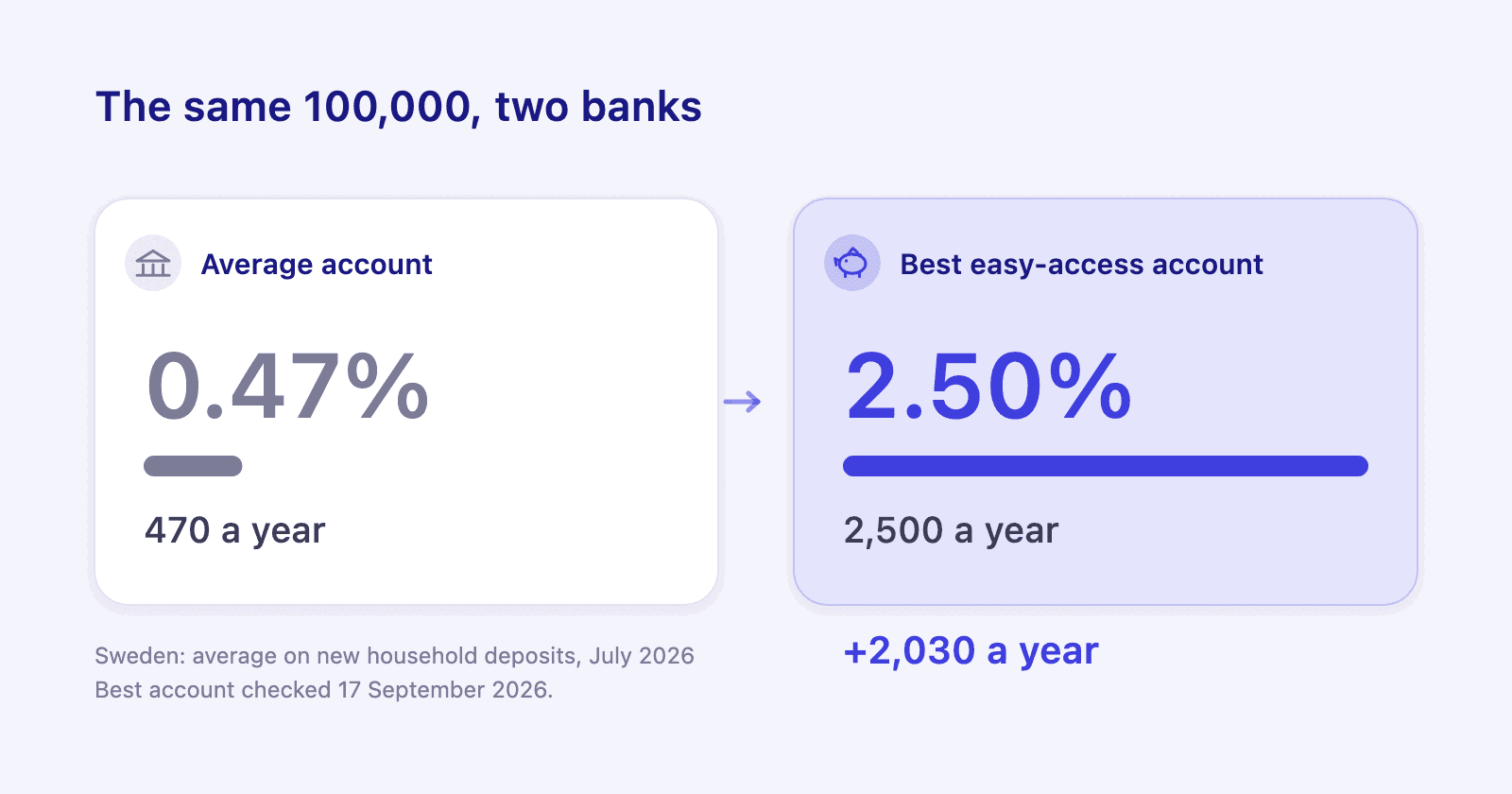
- Swedish households earned 0.47 percent on new bank deposits in July 2026. The best account with free withdrawals paid around 2.50 percent in mid-September.
- Norwegian banks paid 3.12 percent on household deposits in July 2026 and charged 5.31 percent on the mortgages already on their books.
- On a buffer of 100,000, the move from an average account to a good one is worth roughly 1,500 to 2,000 a year before tax.
Why does a rate rise reach your loan but not your savings?
A loan rate is written into a contract that says how and when it follows the market, so a policy rate change reaches it on a schedule the bank has to keep. A deposit rate carries no such promise. The bank sets it, changes it when it wants, and passes on as much or as little as it likes.
The loan side is the part everybody knows. A change in the policy rate works through the money market to the rate on your mortgage, and both the size of the change and the notice you get are set out in your loan agreement. If you want that chain in full, read what a rate change costs you each month and, for Danish mortgages, when a rate rise reaches a home loan.
The savings side has no chain at all. Nothing obliges a bank to raise what it pays you, so the decision comes down to how much it needs your deposits and how likely you are to leave. September 2026 showed both halves in one week: Danmarks Nationalbank lifted its rates by 0.25 percentage points, following the European Central Bank[1], and within days Nykredit Bank and Spar Nord announced that private customers would see no change to deposit or lending rates. Their salary account with home financing and daily banking pays 0.25 percent a year[2].
How do I find out what my own account pays?
Open your bank app, go to the account where the buffer sits and look for the interest rate on the account details screen. If it is not there, open the bank's price list on its website, usually called rates and prices. Check whether the rate is tiered by balance and whether it ends on a date.
Most people never learn this number, because no banking app puts it on the front screen. It takes about two minutes to find:
- Open the account your buffer sits in and look at the account details.
- If no rate is shown there, open the bank's price list on the website and search for the name of the account.
- Check whether the rate is tiered, so a larger balance earns more, or the first tranche earns more than the rest.
- Check whether it is a campaign rate with an end date, and what it drops to afterwards.
- Write the number down and compare it with the best easy-access accounts on a comparison site.
What is the difference worth on a real buffer?
Percentage points are easy to shrug at, so do the sum in money instead. The table uses a buffer of 100,000 in the local currency, the average or typical account in each market, and the best easy-access account found on 17 September 2026.
| Market | Average or typical account | Best easy-access account | Difference per year |
|---|---|---|---|
| Denmark | 0.25% | 2.02% | 1,770 kr |
| Norway | 3.12% | 4.70% | 1,580 kr |
| Sweden | 0.47% | 2.50% | 2,030 kr |
The Norwegian and Swedish averages come from the central statistics offices[3][4]. The Danish figure is the salary account rate Nykredit and Spar Nord quote[2], and the best Danish account was 2.02 percent from Resurs Bank on balances up to 200,000 kroner[5]. Rates move, so check the date on any figure you find, including these.
Savings calculatorSee how your savings grow with compound interest.What should I check before moving the money?
Before you move a buffer
- Deposit guarantee. Denmark covers 100,000 euro per customer per bank, Norway 2 million kroner, Sweden 1,150,000 kronor from 1 January 2026. A foreign bank operating in your country may fall under its home country's scheme instead, so check which one applies.
- Withdrawal terms. A buffer has to be reachable within a day or two. Fixed-term accounts pay more for a reason.
- Caps and tiers. Several of the best rates apply only up to a set balance, or only to the first tranche.
- Campaign rates. A three-month teaser that falls back to near zero is worth less than a lower rate that stays.
- Tax. Interest is taxed as capital income in all three countries, so the figures above are before tax.
Why this is worth doing now rather than later
Moving a savings account is a small job. You open the new account with electronic ID, transfer the money from your own bank app and keep the old account open until the first transfer has landed. That is an evening at most, and it is the same amount of work whether your buffer is 20,000 or 300,000. Compare that with moving a mortgage, which means new documents, a valuation and a fee, and the savings account is plainly the easier one to fix.
The size of the buffer is a separate question from where you keep it. Our guide to the emergency fund covers how many months of fixed costs to aim for. This article is the other half: once the money is there, make sure it is not sitting still.
How Penge helps
Penge connects to more than 2300 banks in over 30 countries, so a buffer in a challenger bank shows up next to your everyday account instead of living in an app you open twice a year. Seeing the balance in the same list as everything else is what keeps a forgotten savings account from staying forgotten. The connection is read-only, and your bank credentials are never stored.
Get a full overview with Penge
Connect your bank and let the app categorize and budget automatically.
Sources
- Danmarks Nationalbank, Renteforhøjelse, 10 September 2026
- Nykredit, Nykredit Bank og Spar Nord holder renten i ro for privatkunder, 11 September 2026
- Statistics Norway, Interest rates in banks and mortgage companies, July 2026
- Statistics Sweden, Financial market statistics, July 2026
- Mybanker, best deposit rates in Denmark, 11 September 2026
- Börskollen, Swedish savings rates compared, 17 September 2026
- Penger.no, Norwegian savings accounts compared
Frequently asked questions
- Does a policy rate rise raise my savings rate?
- Not by itself. A bank decides what it pays on deposits and can leave the rate where it is after a central bank rise, which is what Nykredit Bank and Spar Nord did in September 2026. Loan rates follow the market because the loan agreement says they must.
- Where do I find the interest rate on my savings account?
- In the account details in your bank app, or in the bank's price list on its website. Check whether the rate is tiered by balance and whether it is a campaign rate that ends on a date.
- Is it worth moving a savings account for one percentage point?
- On a buffer of 100,000, one percentage point is 1,000 a year before tax, for an evening of work that you do once. Compared with the effort of moving a mortgage, a savings account is the cheapest rate you can fix.
- Is money in a small bank as safe as in a big one?
- Up to the deposit guarantee, yes. Denmark covers 100,000 euro per customer per bank, Norway 2 million kroner and Sweden 1,150,000 kronor. Check which country's scheme covers the bank, because a foreign bank may be covered by its home country.