
When a rate rise reaches a Danish home loan

Co-founder of Penge · Published 14 September 2026 · 6 min read
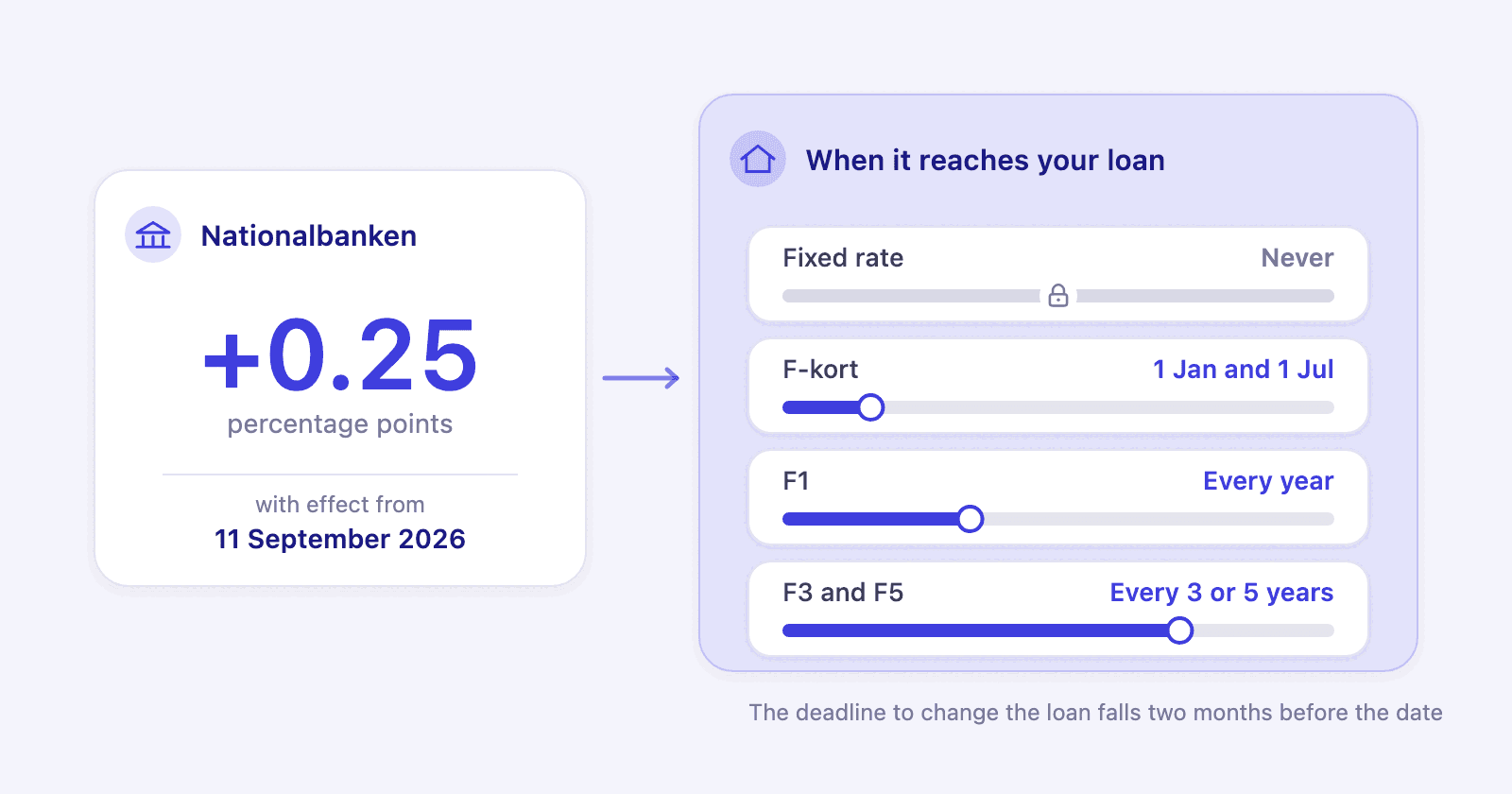
A decision in Frankfurt became a Danish rate rise the same day. It reaches your own home loan on one specific date, and for many loans that date is years away. Here is how to find yours, and what happens on it.
Key takeaways
- Nationalbanken raised its rates by 0.25 percentage points with effect from 11 September 2026. The current account rate, the certificate of deposit rate and the discount rate are now 2.10 per cent, and the lending rate is 2.25 per cent.
- It rose because the ECB raised its own. Denmark runs a fixed exchange rate policy with a central rate of 7.46038 kroner per euro, so Nationalbanken's rate follows the ECB rather than the Danish economy.
- A fixed-rate loan does not move. The rate is locked for the whole term, and the payment stays the same.
- An F-kort gets a new rate on 1 January and 1 July. An F1, F3 or F5 gets one on its own refixing date: 1 January, 1 April, 1 July or 1 October.
- 0.25 percentage points costs 2,500 kroner a year per million borrowed, which is about 208 kroner a month before the interest deduction.
Why does Nationalbanken raise rates when the Danish economy is not asking for it?
Because the krone is pegged to the euro. Denmark takes part in ERM2 with a central rate of 7.46038 kroner per euro and a band of 2.25 per cent either side. If the ECB moves its rate and Nationalbanken does not follow, the rate gap changes and the krone starts to drift. In Denmark the policy rate is a currency tool.
Nationalbanken says it plainly: in calm conditions it normally changes its rates only in step with the ECB changing its own policy rate.[4] That is why Danish inflation and Danish house prices do not appear in the reasoning for a Danish rate rise. The point is to hold the rate gap to the euro area steady, so the krone stays where it belongs.
The ECB raised its three key rates by 0.25 percentage points on 10 September 2026, with effect from 16 September: the deposit facility to 2.50 per cent, main refinancing operations to 2.65 per cent and the marginal lending facility to 2.90 per cent.[2] Energy was the driver. Euro area inflation rose to 3.3 per cent in August from 2.9 per cent in July, with energy alone up 14.3 per cent against 10.3 per cent the month before.[3]
Nationalbanken announced the same day and raised all four of its rates by the same 0.25 percentage points, with effect from 11 September 2026.[1] The Danish rise therefore took effect five days before the ECB's own.
| Rate | Before | After |
|---|---|---|
| Current account rate (foliorenten) | 1.85% | 2.10% |
| Certificate of deposit rate | 1.85% | 2.10% |
| Lending rate (udlånsrenten) | 2.00% | 2.25% |
| Discount rate (diskontoen) | 1.85% | 2.10% |
None of the four is your rate. They are what banks themselves earn and pay on their accounts at Nationalbanken. The route onward to your payment runs through the mortgage system, and that system has dates of its own.
Which loan do you have, and when does it get a new rate?
Look it up in your online bank or on your last statement. A fixed-rate loan never gets a new rate. An F-kort gets one every six months, on 1 January and 1 July. An F1 gets one every year, an F3 every third year and an F5 every fifth, on the date written into your loan terms.
| Loan type | How often | On which dates |
|---|---|---|
| Fixed rate (fastforrentet) | Never | The rate is locked for up to 30 years[8] |
| F-kort | Every six months | 1 January and 1 July[5] |
| F1 | Every year | 1 January, 1 April, 1 July or 1 October[6] |
| F3 | Every third year | The same four dates |
| F5 | Every fifth year | The same four dates |
The F-kort is where a policy move has the shortest route. Its rate has two parts: CITA6, a six-month market rate that moves with the financial markets, and a margin that investors set at auction when the bonds behind the loan are refinanced.[7] CITA6 is reset every 1 January and 1 July. The margin stays put between refinancings.
F1, F3 and F5 work differently. The bonds behind the loan mature and have to be replaced, and your new rate is the price investors will pay for the new bonds at that auction.[6] Nationalbanken's rate is not copied onto your loan. What you get is the market price on the day, and that price has often moved long before the rate decision itself.
The deadline comes before the date
- To change the loan before a refixing, you have to agree it about two months ahead. The deadlines fall at the end of January, April, July and October.
- For loans refixing on 1 January 2027, the deadline is 30 October 2026.
- An F-kort gets its new CITA6 rate automatically. Only the margin needs a refinancing, and that happens every three to five years.
What does 0.25 percentage points cost on your loan?
Multiply the outstanding balance by 0.0025 and divide by twelve. On one million kroner that is 2,500 a year, or 208 a month before the interest deduction. On two million it is 417, and on three million 625. Count only the part of the debt that actually gets a new rate.
This number is worth working out yourself, because it turns a headline into a line in the budget. Take the whole outstanding balance, not what you pay each month, and multiply by the change in percentage points. The arithmetic is the same anywhere, which is why the wider version of it lives in a separate guide covering Norway and Sweden. What follows here is the Danish part.
| Balance | +0.25 points | +0.50 points | +1.00 points |
|---|---|---|---|
| 1,000,000 kr | 208 kr | 417 kr | 833 kr |
| 2,000,000 kr | 417 kr | 833 kr | 1,667 kr |
| 3,000,000 kr | 625 kr | 1,250 kr | 2,500 kr |
| 4,000,000 kr | 833 kr | 1,667 kr | 3,333 kr |
The interest deduction gives part of it back. How much depends on your municipality, and on whether your negative net capital income stays under 50,000 kroner, or 100,000 for a married couple. For the part under that limit, a further tax reduction of 8 per cent is calculated on top.[11] So the 208 kroner costs you less than 208 kroner after tax, while the payment on the statement rises by the full amount.
Loan calculatorWork out the monthly cost and total interest on your loan.The bidragssats does not follow the rate
The bidrag is a separate price. It is what you pay your mortgage lender each term for administering the loan, while the interest is passed on to the investors who bought the bonds behind it. Nationalbanken can raise rates without the bidragssats moving, and the lender can change the bidrag without the rate moving.
Totalkredit states the split clearly: the interest you pay is sent on to the investors, and the bidrag is what the lender itself receives for administering the loan and acting as the middleman.[10] On the statement the two lines sit next to each other and move for different reasons. When the payment goes up, it is worth checking which of them moved before concluding anything about the rate.
What happens to a fixed-rate loan?
The payment does not change. The rate is locked for up to 30 years. What does change is the redemption price, which typically falls when market rates rise, and that makes your equity larger. It opens the door to an opkonvertering: swapping the loan for a new fixed-rate loan at a higher rate and a smaller balance.
Totalkredit describes a fixed-rate loan as one whose redemption price typically falls if rates rise, which grows your equity.[8] An opkonvertering is a switch to a new fixed-rate loan at a higher rate, and the rule of thumb is that the new rate should be at least 1 per cent above the one you hold now.[9] In return the payment goes up, and the gain depends on rates falling again later so the loan can be switched back. That is a calculation your mortgage lender has to run on your own numbers, not a decision to take off the back of a news story.
What about savings?
They move the same way, on the bank's own timing. The foliorente is exactly what banks earn on their deposits at Nationalbanken, so a higher one makes holding money more worthwhile for the bank. Your own deposit rate is still set by your bank, and it moves when the bank decides it does.
This is worth a look precisely when rates have gone up. The buffer tends to sit in the account you opened first rather than the one paying best today. Check what your current account pays, and what the account next to it in the same bank pays.
What to do
- Find the loan type. It is in your online bank and on the statement. If it says fixed rate, you are done: the payment does not change.
- Find the date. An F-kort refixes on 1 January and 1 July. An F1, F3 or F5 has one of the four dates in its loan terms, and the deadline for changing the loan falls two months before it.
- Work out the number. Balance times 0.0025, divided by twelve. Do it for 1.00 percentage points too, so you know the range and not just the next step.
- Decide where the money comes from before the date arrives. Either the buffer account absorbs it for a few months, or one named category in the budget shrinks by exactly that amount.
- Check the savings rate at the same time. If the loan rate is rising, something has usually happened on the other side too.
How Penge helps
The hard part of step four is knowing where the 208 kroner should come from. Penge pulls your transactions from more than 2300 banks and categorizes them automatically when it is sure, so you can see what a year actually goes on instead of guessing. Give interest and bidrag their own category, put a budget on it, and the next refixing becomes a line that has moved rather than a feeling that there is less left. The app is on iPhone, the bank connection is read-only, and your bank credentials are never stored.
Want to check whether your bank is supported? See which banks are supported
Get a full overview with Penge
Connect your bank and let the app categorize and budget automatically.
Sources
- Danmarks Nationalbank, Renteforhøjelse (rate increase), 10 September 2026
- European Central Bank, Monetary policy decisions, 10 September 2026
- Eurostat, Euro area annual inflation up to 3.3%, flash estimate for August 2026
- Danmarks Nationalbank, Pengepolitikken i Danmark (monetary policy in Denmark)
- Totalkredit, F-kort
- Totalkredit, Hvad er rentetilpasning? (what refixing is)
- Nykredit, Skal du snart have nyt rentetillæg på dit F-kort-lån?, August 2026
- Totalkredit, Fastforrentet lån (fixed-rate loan)
- Totalkredit, Opkonvertering af lån
- Totalkredit, Fakta om bidragssatserne
- Den juridiske vejledning C.A.11.2.5, how interest costs are deducted (Denmark)
Frequently asked questions
- When does my home loan get the new rate?
- It depends on the loan type. A fixed-rate loan never gets a new rate. An F-kort gets one on 1 January and 1 July. An F1, F3 or F5 gets one on its own refixing date, which is 1 January, 1 April, 1 July or 1 October, and that happens every year, every third year or every fifth year.
- Why does Nationalbanken follow the ECB?
- Because Denmark runs a fixed exchange rate policy. The krone takes part in ERM2 with a central rate of 7.46038 kroner per euro and a band of 2.25 per cent either side. Holding the rate gap to the euro area steady keeps the krone where it should be. A Danish rate rise is therefore not a statement about the Danish economy.
- What does 0.25 percentage points cost per month?
- 2,500 kroner a year per million borrowed, which is about 208 kroner a month before the interest deduction. Multiply your outstanding balance by 0.0025 and divide by twelve. On two million that is 417 kroner a month, and on three million 625 kroner.
- Does the payment on my fixed-rate loan go up?
- No. The rate on a fixed-rate loan is locked for up to 30 years, so the payment is the same whatever Nationalbanken does. What does change is the redemption price, which typically falls when rates rise, and that makes your equity larger.
- Does the bidragssats rise when the rate rises?
- No, the two are not connected. The bidrag is what you pay your mortgage lender for administering the loan, and the interest is passed on to the investors who own the bonds. The lender can change the bidragssats independently of the rate.