
Norway's 2027 state budget: what the tax cut gives you from January, and what costs more

Co-founder of Penge · Published 7 October 2026 · 7 min read
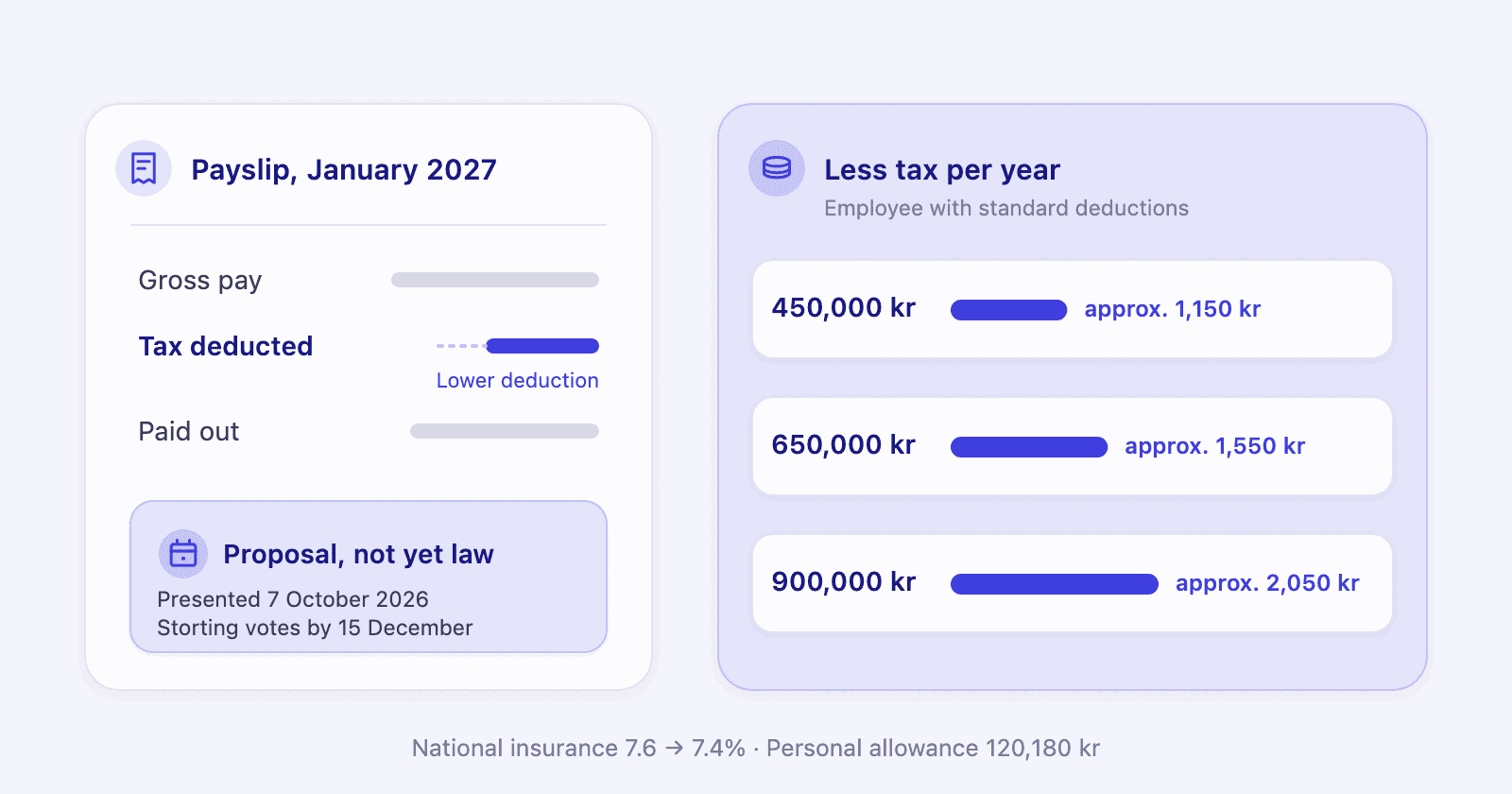
The government wants to cut income tax by about 6.4 billion kroner in 2027, mainly through a lower national insurance contribution and a higher personal allowance. On a 650,000 kroner salary the budget's cut is around 1,550 kroner a year, roughly 130 kroner a month. It is a proposal, presented on 7 October 2026, and the Storting votes on it in November and December.
A proposal, not yet law
- Everything in this article is the government's proposed state budget for 2027, presented on Wednesday 7 October 2026. The government needs a majority in the Storting, and the figures can change in the budget negotiations.
- The rates were checked against the Finance Ministry's tables and Prop. 1 LS (2026–2027) the same day. The tax examples per salary level are our own calculation, and each table says so.
Key takeaways
- The government proposes cutting income tax by about 6.4 billion kroner in 2027. The national insurance contribution on wages falls from 7.6% to 7.4%, and the personal allowance rises from 114,540 to 120,180 kroner.
- The Finance Ministry's own example: on a 750,000 kroner salary with standard deductions, tax falls by about 1,800 kroner in 2027. On 450,000 kroner the cut is around 1,150 kroner, on 900,000 kroner around 2,050 kroner.
- Bracket tax keeps its rates, and the thresholds rise by 4%. The wealth tax allowance goes from 1,900,000 to 1,990,000 kroner. BSU and the tax-free card limit are unchanged.
- Norgespris is proposed at 45 øre per kWh plus duties in 2027. Electricity tax, petrol, diesel, alcohol and tobacco go up slightly, and the VAT exemption for electric cars is halved to 150,000 kroner.
- You first see the tax cut on your January 2027 payslip, when your employer fetches the new tax deduction card. The Storting plans to finish the budget by 15 December.
How much less tax will I pay in 2027?
With standard deductions, the budget lowers your tax by around 0.2% of your salary plus about 250 kroner. That is around 1,150 kroner a year on a 450,000 kroner salary, 1,550 on 650,000 and 2,050 on 900,000. Per month it is between 96 and 171 kroner. The figures are a proposal and can change.
The cut has two parts. The national insurance contribution (trygdeavgift) on wages falls by 0.2 percentage points, from 7.6% to 7.4%, which is 2 kroner less tax per 1,000 kroner you earn.[1] The personal allowance (personfradrag) rises from 114,540 to 120,180 kroner. That is about 1,200 kroner more than a normal adjustment for wage growth, and it lowers tax by around 250 kroner for everyone whose income is high enough to use the whole allowance.[3]
| Annual salary | Less tax per year | Per month |
|---|---|---|
| 450,000 kr | approx. 1,150 kr | approx. 96 kr |
| 650,000 kr | approx. 1,550 kr | approx. 129 kr |
| 750,000 kr | approx. 1,800 kr | approx. 150 kr |
| 900,000 kr | approx. 2,050 kr | approx. 171 kr |
This is how the Finance Ministry counts it too. An employee earning 750,000 kroner with standard deductions pays about 1,800 kroner less tax in 2027, according to the ministry.[4] The national insurance cut alone is 1,500 kroner of that.[3] The distribution table in the bill shows the same pattern: around 1,000 kroner on average for the middle income groups and 3,200 kroner for the top tenth.[3]
These figures are for wages. Pensioners do not get the national insurance cut, because the rate on pensions stays at 5.1%.[1] They do get the higher personal allowance, and the government also raises the tax credit for pension income by up to about 750 kroner, mostly for low pensions.[4] The self-employed see the rate on business income fall from 10.8% to 10.6%.[1]
Why does my tax deduction fall by more than the cut?
Because the bracket tax thresholds and the cap on the standard deduction also rise with expected wage growth of 4%. If you earn the same in 2027 as in 2026, you pay several thousand kroner less tax. A pay rise uses up most of that adjustment, while the cut itself remains.
This table shows the whole tax bill on the same salary in both years. It is useful if your pay does not change from December to January, which is true for many people, since the annual wage settlement comes later in the year. The difference is bigger than in the table above because it also includes the normal yearly adjustment, which is not part of the cut.
| Annual salary | Tax, 2026 rules | Tax, 2027 proposal | Difference per year | Per month |
|---|---|---|---|---|
| 450,000 kr | 93,780 kr | 90,350 kr | 3,430 kr | 286 kr |
| 650,000 kr | 160,980 kr | 157,150 kr | 3,840 kr | 320 kr |
| 900,000 kr | 261,950 kr | 254,800 kr | 7,150 kr | 596 kr |
The jump at 900,000 kroner happens because the bracket 3 threshold moves from 725,050 to 754,050 kroner.[1] Almost 29,000 kroner of salary is then taxed at 4.0% bracket tax instead of 13.7%. If you claim deductions for interest, commuting or anything else, your figures will differ. The Norwegian Tax Administration's tax calculator for 2027 is the best place to check them once it is out.
Which tax rates change in 2027?
The national insurance contribution on wages goes from 7.6% to 7.4%, and the personal allowance from 114,540 to 120,180 kroner. Tax on ordinary income stays at 22%, and bracket tax keeps its rates. The thresholds and the cap on the standard deduction rise by 4%. BSU, the tax-free card limit and the commuting deduction stay the same in kroner.
| 2026 | Proposal 2027 | |
|---|---|---|
| Personal allowance | 114,540 kr | 120,180 kr |
| National insurance, wages | 7.6% | 7.4% |
| National insurance, business income | 10.8% | 10.6% |
| National insurance, pensions | 5.1% | 5.1% |
| Tax on ordinary income | 22% | 22% |
| Bracket tax, step 1 (1.7%) | from 226,100 kr | from 235,150 kr |
| Bracket tax, step 2 (4.0%) | from 318,300 kr | from 331,050 kr |
| Bracket tax, step 3 (13.7%) | from 725,050 kr | from 754,050 kr |
| Bracket tax, step 4 (16.8%) | from 980,100 kr | from 1,019,300 kr |
| Bracket tax, step 5 (17.8%) | from 1,467,200 kr | from 1,525,900 kr |
| Standard deduction on wages, cap | 95,700 kr | 99,550 kr |
| Wealth tax allowance (single) | 1,900,000 kr | 1,990,000 kr |
| BSU, maximum saved per year | 27,500 kr | 27,500 kr |
| Tax-free card limit (frikort) | 100,000 kr | 100,000 kr |
Wealth tax gets a higher allowance, 1,990,000 kroner for a single person and twice that for a married couple. The rates stay as they are.[1] BSU, the home savings scheme for under-34s, stays the same in kroner: you can still save 27,500 kroner a year and get a 10% tax credit, up to 300,000 kroner in total.[1] The tax-free card limit stays at 100,000 kroner.[3]
What gets more expensive in 2027?
Most duties on goods rise with inflation, 2.7%. Electricity tax goes from 7.13 to 7.32 øre per kWh, and alcohol, tobacco and snus cost slightly more. Petrol and diesel go up by a few tens of øre per litre. The biggest change is that the VAT exemption for new electric cars only covers the first 150,000 kroner.
| Duty | 2026 | Proposal 2027 |
|---|---|---|
| Electricity tax | 7.13 øre/kWh | 7.32 øre/kWh |
| Petrol, road use and CO2 tax | 7.57 kr/l | 7.77 kr/l |
| Diesel, road use and CO2 tax | 6.70 kr/l | 6.97 kr/l |
| Cigarettes | 331 kr per 100 | 340 kr per 100 |
| Snus | 102 kr per 100 g | 105 kr per 100 g |
| VAT exemption, new electric cars | up to 300,000 kr | up to 150,000 kr |
Fuel duty has two parts that move in opposite directions. The CO2 tax on petrol rises from 3.80 to 4.40 kroner per litre, while the road use tax falls from 3.77 to 3.37.[2] Together that is 20 øre more per litre before VAT, around 25 øre with VAT. For diesel it is 27 øre before VAT. The government says the aim is to keep duties on petrol and diesel unchanged in real terms.[3]
Electricity tax is a small item. 0.19 øre more per kWh is around 30 kroner a year before VAT for a household using 16,000 kWh. The VAT exemption for electric cars matters more if you are buying a new car: it covers the first 150,000 kroner instead of 300,000, and the government expects it to raise 3.8 billion kroner in 2027.[6] If you are buying a new electric car around new year, ask the dealer which date decides the rules for your car.
What does the budget mean for my electricity bill?
Norgespris, the state's fixed electricity price, is proposed at 45 øre per kWh plus duties in 2027, up from 40 øre this year. With 25% VAT that is around 56 øre. The electricity subsidy covers 90% of the price above 79 øre per kWh before duties. Whether to choose Norgespris or spot price is a separate decision.
The government estimates that Norgespris and the electricity subsidy for households will cost just under 16.4 billion kroner in 2027.[5] Your Norgespris ends on 31 December 2026 and does not renew by itself. We cover the choice for 2027 in Norgespris or spot price in 2027.
When will I see the tax cut on my payslip?
In January 2027. The Norwegian Tax Administration makes a new tax deduction card for 2027 once the Storting has adopted the tax rules, and your employer fetches it. The 2026 card came out on 15 December 2025. You do not need to do anything to get the cut, but you should check that the figures on the card are right.
The tax deduction card for 2026 came out on 15 December 2025, and 4.4 million people were told it was ready.[7] Employers and NAV fetch the card directly from the Tax Administration. If you change it, they fetch the new version without you having to tell them.[7]
With table deduction (tabelltrekk), the whole year's tax is spread over 10.5 months. No tax is deducted in June, and only half in December.[8] The cut is spread over the same months, so on a normal payslip the difference is slightly larger than the yearly amount divided by twelve. Compare January 2027 with November 2026, not with December, where half tax makes every number look odd.
Can the proposal change before January?
Yes. Labour governs as a minority and needs support from other parties to pass the budget. Tax rates, duties and Norgespris can all change in the negotiations. Under the Storting's own plan, the finance committee reports by 20 November, and the whole budget is to be adopted by 15 December.
Under the Storting's budget cycle, it votes on the spending frame for each area by 27 November, and the final budget is to be finished by 15 December.[9] The figures in this article are what the government has proposed, not what will apply. We will update the article once the budget is adopted.
What should I do before January?
Do not spend the cut before it is adopted. Decide on Norgespris before new year, top up your BSU for 2026 before new year, and check your tax deduction card when it arrives in December. If you are buying a new electric car, find out which VAT rules apply to it.
- Hold off spending it. A hundred kroner a month is a proposal until the Storting votes, and it could end up higher or lower.
- Make the electricity choice. The 2027 price is proposed, and Norgespris or spot price in 2027 shows how to work it out on your own usage.
- Top up your BSU for 2026. Deposits made by 31 December count for this year. The maximum is 27,500 kroner a year, in 2027 as well.
- Check your tax deduction card in December. If it shows the wrong income, debt or deductions, change it on skatteetaten.no. Too little withheld means tax to pay the following year.
- If you are buying a new electric car costing more than 150,000 kroner, ask the dealer what the new VAT exemption means for the price, and which date applies.
- Look at your January payslip. If the deduction is not lower than in November on the same pay, check your tax deduction card first.
How Penge helps
A cut of 130 kroner a month disappears quickly in an ordinary month. Penge fetches your transactions from more than 2300 banks, so your January salary payment sits right next to November's, and you can see whether it actually went up. If you want the money to go somewhere specific, give it its own category and a budget. The app is available for iPhone, the bank connection is read-only, and your bank credentials are never stored.
Want to check whether your bank is supported? See which banks are supported
Get a full overview with Penge
Connect your bank and let the app categorize and budget automatically.
Sources
- Finance Ministry: Tax rates 2027, rates for 2026 and the government's proposal for 2027 (Norwegian)
- Finance Ministry: Duty rates 2027, rates for 2026 and the government's proposal for 2027 (Norwegian)
- Prop. 1 LS (2026–2027) Skatter og avgifter 2027 (Norwegian)
- Finance Ministry: Proposes billion-kroner cut in income tax, press release 7 October 2026 (Norwegian)
- Finance Ministry: A budget that keeps Norway safe in an unsafe time, press release 7 October 2026 (Norwegian)
- Finance Ministry: Revenue effects of tax and duty changes for 2027 (Norwegian)
- Norwegian Tax Administration: You can now check your tax deduction card for 2026, press release 15 December 2025
- Norwegian Tax Administration: The numbers in your tax deduction card
- Storting: The budget cycle (Norwegian)
Frequently asked questions
- What is the personal allowance in Norway in 2027?
- The government proposes a personal allowance of 120,180 kroner in 2027, up from 114,540 kroner in 2026. That is about 1,200 kroner more than a normal adjustment for wage growth, and it lowers tax by around 250 kroner. The proposal was presented on 7 October 2026 and needs the Storting's approval.
- What is the national insurance contribution in Norway in 2027?
- The government proposes 7.4% on wages in 2027, down from 7.6%. On business income the rate goes from 10.8% to 10.6%, while the rate on pensions stays at 5.1%. On a 750,000 kroner salary, the lower rate cuts tax by 1,500 kroner a year.
- How much less tax will I pay on a 650,000 kroner salary?
- Around 1,550 kroner a year, roughly 130 kroner a month, compared with the 2026 rules adjusted for wage growth. That is 0.2% of salary from the national insurance cut plus about 250 kroner from the personal allowance. On the same salary as in 2026, tax falls by around 3,800 kroner, because bracket tax and the standard deduction are also adjusted.
- When does the 2027 tax deduction card come out?
- The Norwegian Tax Administration has not set a date. The 2026 card came out on 15 December 2025. Your employer fetches the new card itself, so the new deduction shows on your January payslip without you doing anything. Check that the income and deductions on the card are right anyway.
- Has the 2027 tax cut been adopted?
- No. The government presented the proposal on 7 October 2026, and Labour needs support from other parties in the Storting. Under the Storting's plan, the budget is to be adopted by 15 December 2026. The figures can change in the budget negotiations before then.