
The interest on your Norwegian student loan, and what it costs

Co-founder of Penge · Published 20 September 2026 · 7 min read
The student loan rate is the one rate almost everyone in Norway has paid, and the one almost nobody can explain. Norges Bank does not set it, and your own bank does not either. Here is the arithmetic behind it, and what it means for your monthly bill.
Key takeaways
- Lånekassen's floating rate on student loans is 4.707 per cent from 1 November 2026, up 0.105 percentage points from 4.602 per cent.
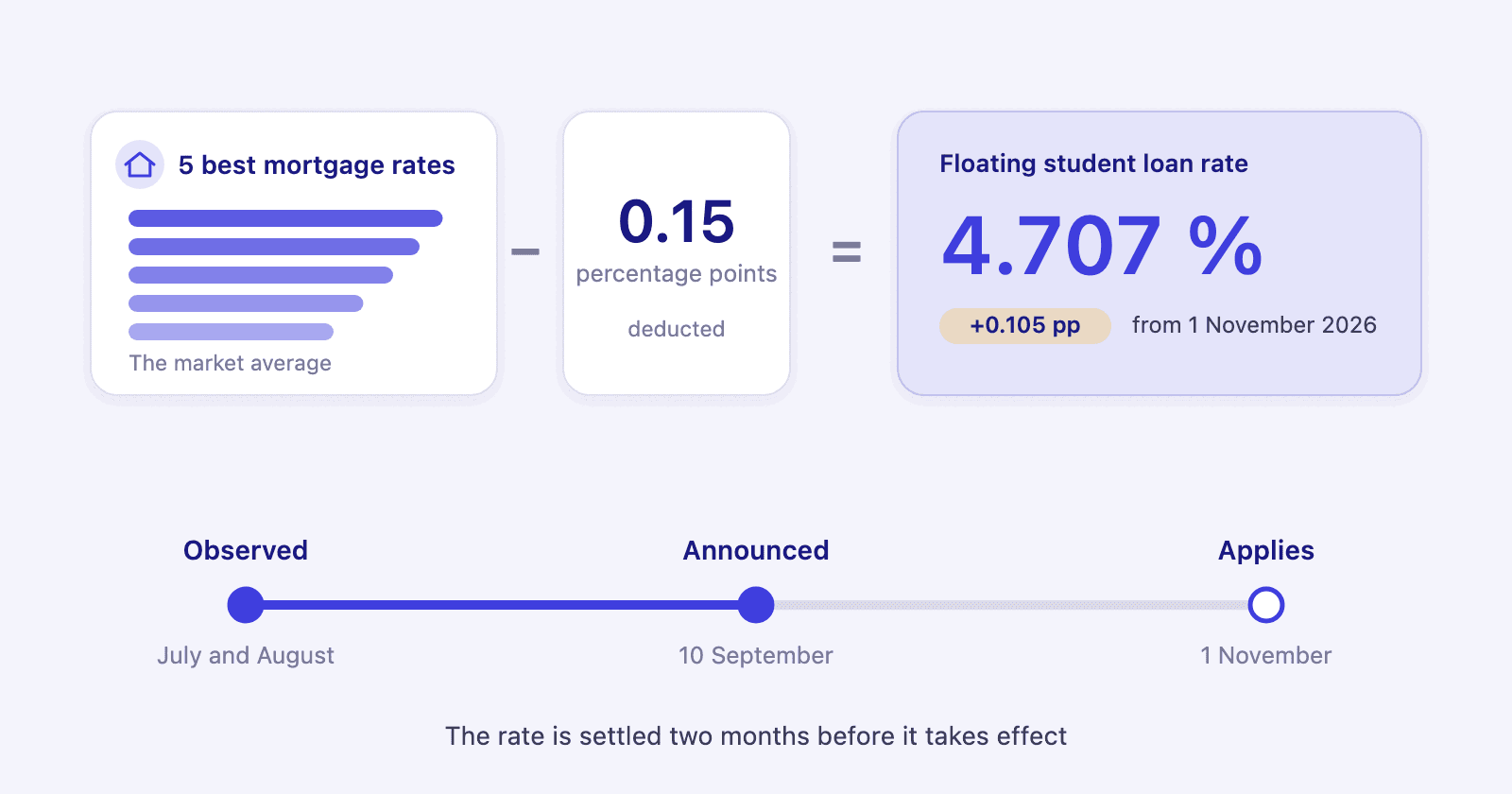
- The rate is the average of the five best mortgage offers in the market, minus 0.15 percentage points. Finanstilsynet observes the market and sets the rate.
- For the floating rate the observation period is two months, followed by two months before the rate takes effect. The rate is settled before it is announced.
- The change applies automatically to everyone on the floating rate. The monthly amount adjusts, while the repayment period stays as it is.
- 780,200 borrowers are on the floating rate and 9,800 have fixed theirs. All three fixed rates from 1 September 2026 sit above the floating rate.
Checked on 20 September 2026
- The figures come from Lånekassen's own pages, not from newspaper reports.
- The floating rate is set every other month. The 4.707 per cent rate applies for November and December 2026.
- The fixed rates in this article apply from 1 September 2026. New fixed rates are announced every other month.
What is the student loan rate now?
The floating rate is 4.707 per cent from 1 November 2026, up from 4.602 per cent. It applies for November and December. Lånekassen sets the floating rate every other month, so the next rate applies from 1 January 2027. Everyone who starts repaying gets the floating rate automatically unless they apply to fix it.
Lånekassen announced the change on 10 September 2026. The rise is 0.105 percentage points, and the rate applies in November and December.[1] It is a small move, but the mechanism behind it is worth understanding, because it is the same one every time.
First, what this rate is not. It is not the policy rate, which Norges Bank sets, and it is not your own bank's mortgage rate. Lånekassen does a third thing, described below, so the result can move out of step with both.
| Applies from | Floating rate |
|---|---|
| 1 November 2026 | 4.707 % |
| 1 September 2026 | 4.602 % |
| 1 July 2026 | 4.602 % |
| 1 May 2026 | 4.611 % |
| 1 March 2026 | 4.621 % |
| 1 January 2026 | 4.698 % |
How does Lånekassen set the rate, and can I see the next change coming?
The rate is the average of the five best mortgage offers in the market, minus 0.15 percentage points. Finanstilsynet makes the observation and sets the rate. For the floating rate the observation period is two months, followed by two months before the rate applies. The method is the same for fixed and floating.
The arithmetic is public and simple. Lånekassen takes the average of the five best mortgage offers in the market and deducts 0.15 percentage points. Finanstilsynet, the financial supervisory authority, observes how mortgage rates move and sets Lånekassen's rates.[1] The student loan rate is a mirror of the mortgage market with a small discount, not a rate decided by politics.
The delay is the useful part. For the floating rate the observation period is two months, with two months before the rate takes effect.[1] The rate that applies from 1 November was observed over July and August, and announced on 10 September. So the rate that applies from 1 January 2027 is being observed over September and October 2026, and will be announced in early November.
Watch the cheapest mortgage rates in the market now and you have a rough view of where your student loan rate lands at new year, before Lånekassen says so. For the fixed rates the observation period is shorter: one month, with one month's delay.[1]
What does a rate change cost me per month?
Multiply your debt by the change in percentage points and divide by twelve. 0.105 percentage points on 457,000 kroner is 480 kroner a year, so 40 kroner in the first month. The monthly bill rises by less than that over time, because the balance shrinks across the repayment period.
A newly graduated student had 457,000 kroner of student debt on average in 2024, according to Lånekassen's own figures. Someone who studied in Norway had 434,000 kroner, while someone who studied abroad had 754,000 kroner.[7] The table below uses those as examples, not as a guess at your own debt.
Most people get a repayment plan running over 20 years.[6] The table works out the monthly amount as an annuity over 20 years, as an illustration. Your real monthly amount is on Dine sider and depends on how far into repayment you are.
| Debt | At 4.602 % | At 4.707 % | Increase per month |
|---|---|---|---|
| 300,000 kr | 1,915 kr | 1,932 kr | 17 kr |
| 457,000 kr | 2,916 kr | 2,943 kr | 26 kr |
| 600,000 kr | 3,829 kr | 3,863 kr | 34 kr |
| 754,000 kr | 4,812 kr | 4,855 kr | 43 kr |
The point of the table is the order of magnitude, not the exact figures. A change of a tenth of a percentage point is twenty to forty kroner a month on ordinary student debt. Worth knowing, and rarely worth doing anything dramatic about.
The change happens on its own. You do not apply for anything, and you do not get a choice. On a floating rate the amount you pay each month can change a little according to the rate in force.[8] Your repayment period stays as it is unless you change the plan yourself on Dine sider.
Loan calculatorWork out the monthly cost and total interest on your loan.Should I fix the rate?
The fixed rates from 1 September 2026 are 5.233 per cent for three years, 5.099 for five and 4.946 for ten. All three sit above the floating rate of 4.707 per cent. You pay more today to avoid a rise later. There are six chances a year to apply.
| Rate | Level | What it does |
|---|---|---|
| Floating | 4.707 % | Changes every other month, automatic for everyone |
| Fixed, 3 years | 5.233 % | Locked for three years, the monthly amount holds still |
| Fixed, 5 years | 5.099 % | Locked for five years |
| Fixed, 10 years | 4.946 % | Locked for ten years |
All three fixed rates came down from 1 September 2026 and still sit above the floating rate.[2] That is normal. A fixed rate is the price of a predictable bill, not an offer to pay less. The question is not which rate is lowest today, but whether you can live with a monthly amount that moves by a few tens of kroner.
The practical details before you fix: new fixed-rate offers arrive every other month, with an application window of about a week.[8] That is six chances a year.[1] Once fixed, you cannot change your repayment period, and if you pay extra or clear the loan, Lånekassen works out an interest loss or gain that is added to or deducted from your debt.[6]
Almost nobody does it. 780,200 borrowers are on the floating rate, while 9,800 have fixed theirs.[1]
What if the monthly amount gets too high?
You can defer a bill up to 36 times across the repayment period, with no reason given. The repayment period extends by the same amount, and interest still accrues while you do not pay. If you are ill, unemployed or on a low income, you can also apply to have interest cancelled.
- **Betalingsutsettelse, deferring a bill.** Everyone can defer 36 bills in total, which is three years. No reason needed. Defer one bill and the repayment period extends by one month, and interest is added for the months you do not pay.
- **Sletting av renter, cancelling interest.** Illness, unemployment, work assessment allowance or a low income can give you the right to have interest already added to the loan cancelled. You can apply up to three years back. Deferrals used in a period where interest is cancelled are given back to you.
- **Paying extra.** Pay more than the bill and you reduce the debt, and the fixed monthly amount drops for the rest of the period. You still get a bill every month, and you cannot pay future bills in advance.
- **A shorter repayment period.** On a floating rate you can change the repayment plan on Dine sider, and change it back later.
The order matters once you have used all 36 deferrals. Then you must apply to have interest cancelled first, and for a deferral after that.[5] The main thing is to apply before the due date. Lånekassen's late fees are higher than most places, and a first reminder costs 280 kroner on top of two monthly payments.[4]
Before clearing the loan early to be done with it, know what you give up. A loan from Lånekassen comes with free debt insurance on disability and death, and the right to defer payments and have interest cancelled if things go wrong. Once the loan is paid off, you have neither.[6]
How Penge helps
The student loan is usually the one fixed monthly amount that changes without anyone asking you. Penge connects to more than 2300 banks across over 30 countries and categorises spending automatically when it is confident, so the bill from Lånekassen sits in the monthly picture next to everything else. Give it a category of its own and you see the month the amount moves, instead of working it out when the account is emptier than expected. The connection is read only, and your bank credentials are never stored.
Want to check whether your bank is supported? See the supported banks
Get a full overview with Penge
Connect your bank and let the app categorize and budget automatically.
Sources
- Lånekassen, Ny flytende rente: 4,707 prosent, 10 September 2026
- Lånekassen, Fastrentene på studielån går ned, 10 August 2026
- Lånekassen, Historisk renteutvikling
- Lånekassen, Betalingsutsettelse
- Lånekassen, Arbeidsledig, AAP, syk og lav inntekt
- Lånekassen, Innfri lånet eller betale raskere
- Lånekassen, Studiegjelden øker, men misligholdet er lavt, 12 June 2025
- Lånekassen, Renter og gebyrer
Frequently asked questions
- What is the interest rate on a Norwegian student loan in 2026?
- The floating rate is 4.707 per cent from 1 November 2026, up from 4.602 per cent in September and October. The fixed rates from 1 September 2026 are 5.233 per cent for three years, 5.099 per cent for five years and 4.946 per cent for ten years.
- How is the Lånekassen interest rate calculated?
- It is the average of the five best mortgage offers in the market, minus 0.15 percentage points. Finanstilsynet observes mortgage rates and sets the levels. The method is the same for fixed and floating rates, but the observation period differs.
- Do I have to do anything when the rate changes?
- No. The change applies automatically to everyone on the floating rate. The monthly amount adjusts a little to the rate in force, while the repayment period stays as it is unless you change the repayment plan yourself on Dine sider.
- How many times can I defer a bill from Lånekassen?
- 36 times in total across the repayment period, which is three years. You do not need to give a reason. The repayment period extends by the same amount, and interest is added for the months you do not pay.
- When can I apply for a fixed rate?
- New fixed-rate offers come every other month, with an application window of about a week. That is six chances a year, and you can fix the rate for three, five or ten years. Once fixed, you cannot change your repayment period.