
Sweden's 2027 property assessment: what to do before 2 November

Co-founder of Penge · Published 24 September 2026 · 7 min read
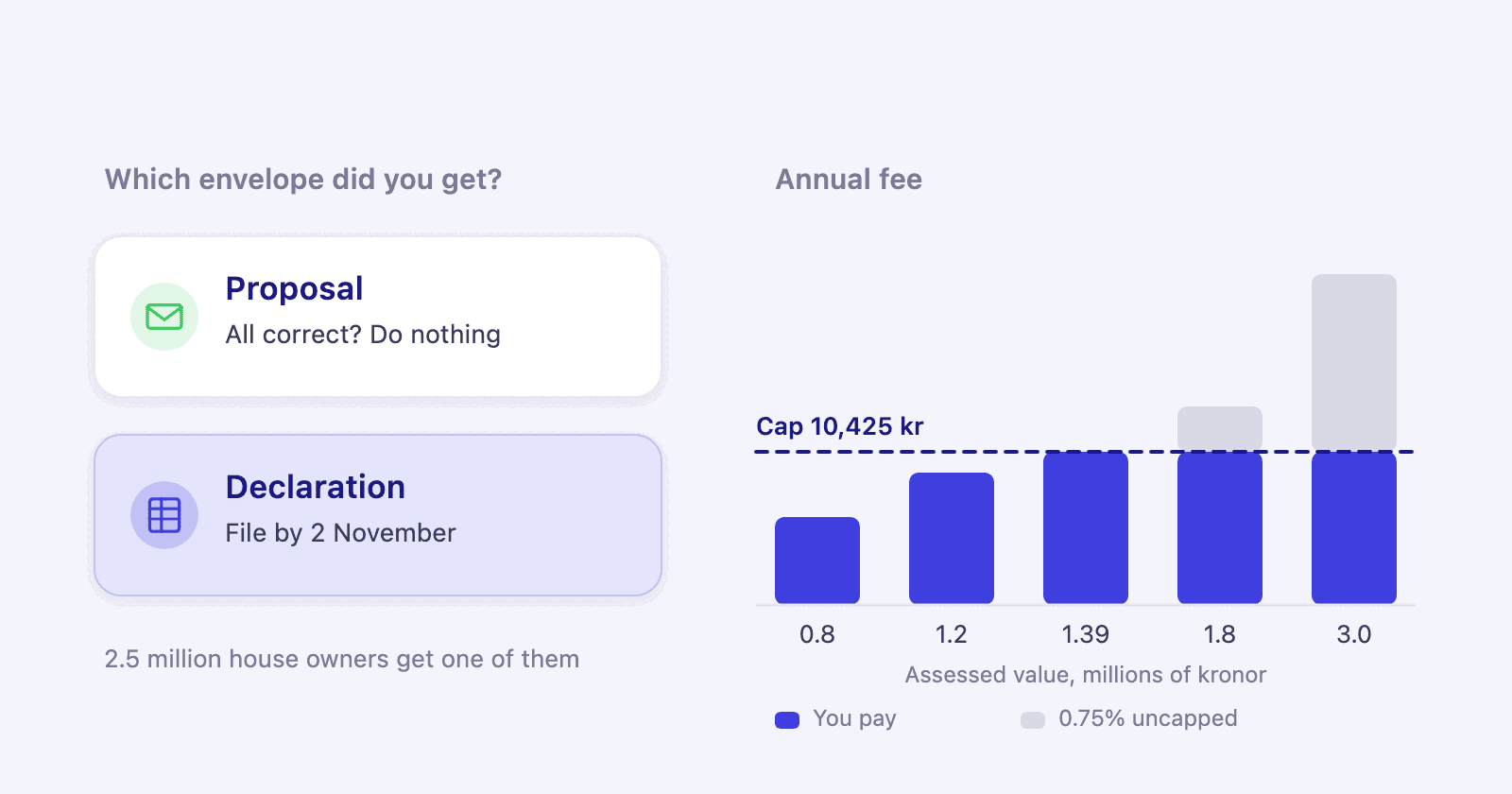
If you got a taxeringsförslag and everything on it is correct, you do not have to do anything. If you got a fastighetsdeklaration, you have details to file by 2 November 2026. And a higher assessed value only costs you more while 0.75 percent of it stays below the cap.
Key takeaways
- If you got a taxeringsförslag and everything is correct, you do not have to do anything at all. If you got a fastighetsdeklaration, you must file by 2 November 2026.
- The fee on a Swedish house is 0.75 percent of the assessed value, but never more than the cap. For income year 2026 the cap is 10,425 kronor per dwelling building.
- At the 2026 cap, the ceiling bites at an assessed value of 1,390,000 kronor. Above that you pay the same fee however far the value rises.
- Assessed values are expected to fall by 3 percent on average, because house prices have dropped across much of the country since the last assessment.
- The decision arrives in mid-June 2027, and the value holds until the next house assessment in 2030.
Checked on 24 September 2026
- The cap for income year 2027 has not been published. It tracks the inkomstbasbelopp and is set later, so the figures here use the 2026 cap of 10,425 kronor.
- The new assessed value first affects the fee for income year 2027, which you declare in spring 2028.
- Everything you report must describe the property as it stands on 1 January 2027.
Did you get a proposal or a declaration?
That decides what you must do. A taxeringsförslag carries a finished proposal for your new assessed value, and if everything is correct you do not have to do anything at all. A fastighetsdeklaration means you have details to report and file. The last day to declare or change anything is 2 November 2026.
The letters went out during September to about 2.5 million house owners. Skatteverket is plain about the split: if you got a proposal and everything is correct, you do not have to do anything at all, while anyone who got a declaration has details to report and file.[2]
The e-service Fastighetsdeklaration, småhus opened on 7 September 2026. Paper forms started going out on 23 September to those without a digital brevlåda.[2] With a digital brevlåda no form arrives by post at all, only a message that the declaration is waiting in the e-service.[1]
If several of you own the property, only one of you gets the letter, usually whoever is listed first on the title deed. Any co-owner can then file, and only one of you needs to. The decision is sent separately to each co-owner, stating the share they own.[1]
| Date | What happens |
|---|---|
| 7 September 2026 | The e-service opens |
| 23 September 2026 | Paper forms start going out |
| 2 November 2026 | Last day to declare or change details |
| Mid-June 2027 | Decision to those with a digital brevlåda |
| Early July 2027 | Decision by post to everyone else |
| 2030 | The next house assessment, a simplified one |
How is the new assessed value worked out?
The assessed value should equal 75 percent of the likely market value in your value area two years before the assessment year. For the 2027 assessment it is sales during 2023 to 2025, and the price level in 2025, that decide whether your value rises or falls. That level then holds until 2030.
Many owners get a lower value this time. House prices have fallen across much of the country since the last assessment, and values are expected to drop by 3 percent on average.[2] An average hides wide differences between value areas, so your own value may well move the other way.
Location decides most of it. The country is divided into value areas, and it is the sales inside your area that set the level.[1] Two identical houses in different areas can move in opposite directions in the same year.
For 2027 Skatteverket has also updated the years used for maintenance and rebuilding standard. That can cut the standard points on your building, and with them the value, without you having touched the house.[1]
What does the new value do to your annual fee?
You pay 0.75 percent of the assessed value, but never more than the cap. For income year 2026 the cap is 10,425 kronor per dwelling building. If 0.75 percent of your new value lands above that, you pay the cap, and a rise in the assessed value then costs you nothing extra.
Work the threshold out yourself: the cap divided by 0.75 percent. At the 2026 cap of 10,425 kronor, the ceiling bites at an assessed value of 1,390,000 kronor.[3] If your house is already above that line, it makes no difference to the fee whether the new value comes out at 1.5 million or 3 million. You pay the cap either way.
| Income year | Cap per dwelling building | Cap bites at an assessed value of |
|---|---|---|
| 2024 | 9,525 kr | 1,270,000 kr |
| 2025 | 10,074 kr | 1,343,200 kr |
| 2026 | 10,425 kr | 1,390,000 kr |
| 2027 | Not published yet | Follows the cap |
The cap is index-linked and follows the yearly change in the inkomstbasbelopp, so it creeps up each year.[3] The threshold where it bites rises at the same pace. The cap for income year 2027 has not been published, so the table below uses the 2026 level.
| Assessed value | 0.75 percent | Fee payable |
|---|---|---|
| 800,000 kr | 6,000 kr | 6,000 kr |
| 1,200,000 kr | 9,000 kr | 9,000 kr |
| 1,390,000 kr | 10,425 kr | 10,425 kr |
| 1,800,000 kr | 13,500 kr | 10,425 kr |
| 3,000,000 kr | 22,500 kr | 10,425 kr |
The cap applies per dwelling building, not per property. With two dwelling buildings on one plot you pay the fee for both, so the total can add up to several caps.[3]
The fee never arrives as a bill of its own. The basis for it is filled in on your income tax return and settled in your final tax calculation.[3] The decision lands in June 2027, and the value sets the fee for income year 2027, which you declare in spring 2028.
Who pays less, or nothing at all?
New houses with a value year of 2012 or later pay no fee for their first 15 years. Pensioners in their permanent home usually pay no more than 4 percent of their income, with a floor of 4,042 kronor for income year 2026. Whoever owned the property on 1 January pays for the whole year.
The value year is usually the year the house was finished, and you find it in your latest assessment decision or on Mina sidor. A house with value year 2026 pays no fee for income years 2027 to 2041.[3] Check the details anyway, because the value carries over to the day the fee does start.
The pensioner reduction comes as a tax credit and requires that the property is a house and your permanent home, that you owned it for the whole income year, and that you lived there the whole year. There is a floor: for income year 2026 the lowest possible fee is 4,042 kronor, even if 4 percent of your income would be less.[3]
If the house changed hands during the year, the owner on 1 January pays the fee for the whole income year on their tax return, even when buyer and seller split the cost between them at completion.[3]
What should you check before you file?
Everything must describe the property as it stands on 1 January 2027. Go through living area, secondary area, plot size, build year and the standard of the kitchen and bathroom. Anything you have extended or renovated since 2024 belongs in there. A mistake follows you to the next assessment in 2030.
That is the whole reason to spend fifteen minutes on the proposal: the value stands for three years. One that is too high costs you every year until 2030, and one that is too low for the wrong reason is not something you want to find out about later either.
- Living area and secondary area. Skatteverket measures by its own rules, so the figure in an old listing does not always match.
- Standard points for kitchen, bathroom and heating. A renovation since 2024 raises them, and a standard nobody has updated may sit too high.
- Build year and value year, which decide whether you fall inside the 15 fee-free years.
- Plot size, water and drainage, and whether the property sits close to the shore.
- Planning permission for a build that is not finished, since a house under construction is taxed under the state property tax instead.
If your property differs from the others in its value area you can ask for the assessed value to be adjusted. You do that under the heading Lämna övriga uppgifter, and in some cases you must back the reasons up with documentation. Where Skatteverket has already entered an adjustment for your particular reason, you need not ask for one.[1]
File the declaration late and you risk a late fee.[4] If you need more time you can apply for an extension, but it takes special reasons, meaning circumstances outside your control. The application should reach Skatteverket at least ten days before the filing deadline, and an extension normally runs no later than the end of February 2027.[5]
Budget calculatorSplit your income with the simple 50/30/20 rule.Making room for the fee in your budget
This is a yearly cost that never shows up as a single bill. It sits inside your final tax calculation, and if too little was withheld during the year it surfaces as back tax.[3] That is an unpleasant way to meet a cost: all at once, and long after it arose.
Turn it into a monthly figure instead. The full cap of 10,425 kronor is 869 kronor a month. An assessed value of 900,000 kronor gives 6,750 kronor a year, or 563 kronor a month. Put that aside every month and the money is there when the tax is settled.
Spreading yearly bills across the year covers the method, and Sinking funds how to keep the money apart until it is needed.
Penge runs on iPhone and connects to more than 2300 banks in over 30 countries. Enter the fee as a yearly cost and it is spread across twelve months in the budget instead of landing in one go.
Get a full overview with Penge
Connect your bank and let the app categorize and budget automatically.
Frequently asked questions
- Do I have to reply to the proposal?
- No, not if everything on it is correct. If you got a taxeringsförslag and the details are right, you do not have to do anything at all. If something needs changing, do it by 2 November 2026.
- What happens if I miss 2 November?
- File the declaration late and you risk a late fee. If you need more time you can apply for an extension, but it takes special reasons, and the application should reach Skatteverket at least ten days before the filing deadline.
- How much does my fee rise if the assessed value goes up?
- The fee is 0.75 percent of the assessed value up to the cap. At the 2026 cap of 10,425 kronor, the ceiling bites at an assessed value of 1,390,000 kronor. Above that line you pay the same as before, however far the value rises.
- When does the new assessed value take effect?
- The decision arrives in mid-June 2027 if you have a digital brevlåda, otherwise by post in early July. The value sets the fee for income year 2027, which you declare in spring 2028, and it holds until the next house assessment in 2030.
- We own the house together, do we both have to file?
- No. The letter goes to only one of you, usually whoever is listed first on the title deed, and any co-owner can file it. The decision is then sent to each co-owner separately, stating the share they own.