
Yearly bills: how to stop one month paying for twelve

Co-founder of Penge · Published 15 September 2026 · 6 min read
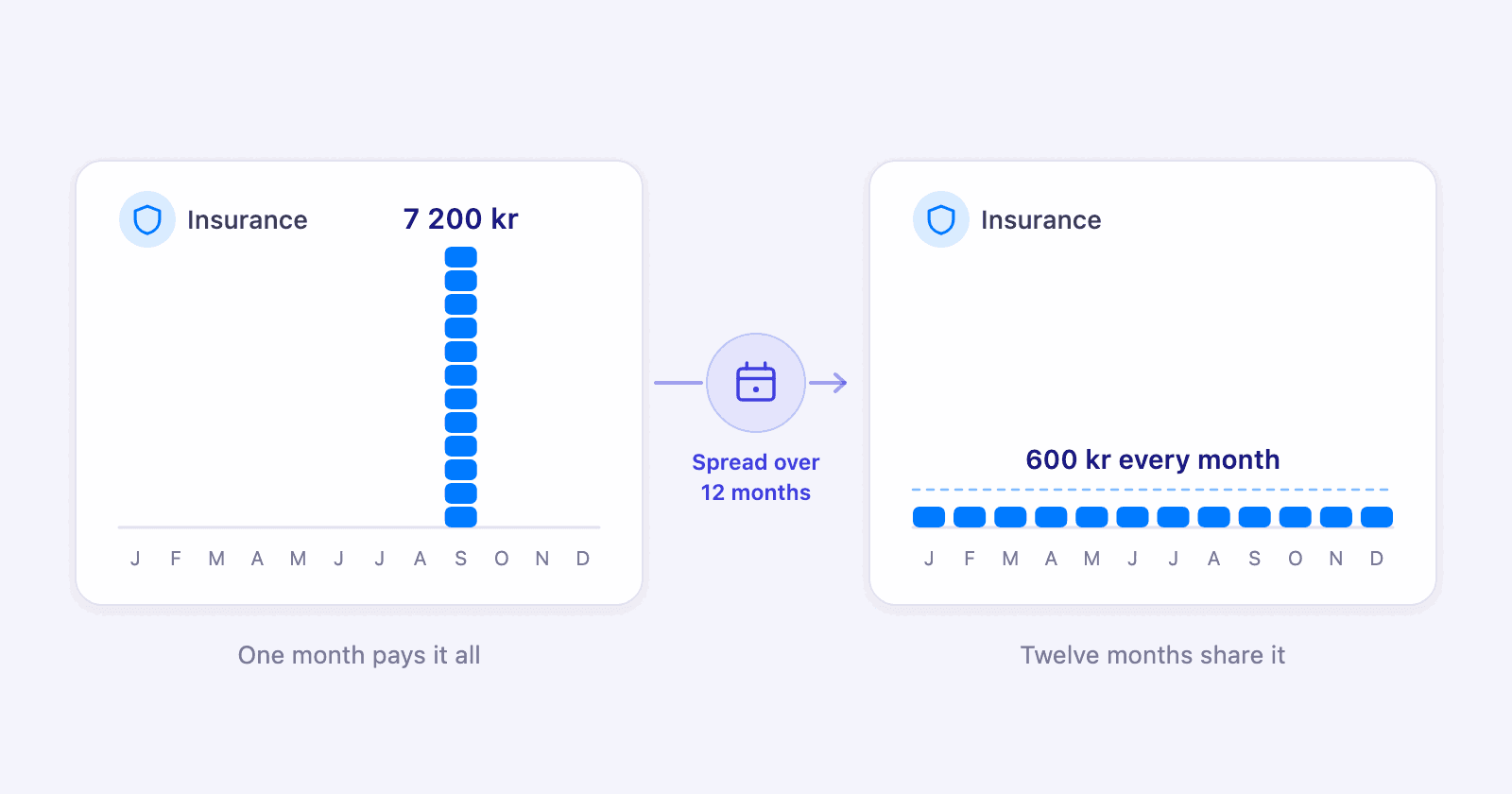
A bill that comes once a year is still a monthly cost. It just arrives in one lump, which makes one month look reckless and eleven look tidier than they were. Here is how to put a yearly cost back into every month it covers.
Key takeaways
- A yearly bill covers twelve months. Divide it by twelve and you have the figure to plan with.
- Paid in one lump, it distorts the year twice: the month you pay reads as overspending, and the other eleven read as cheaper than they were.
- Add up every once-a-year charge before you judge any of them. Each one shows up only once, so they are easy to miss one at a time.
- Two fixes work together. Set money aside every month so the bill is covered, and count the cost across the months it covers rather than the month it left your account.
- Counting a cost across months changes how you read the month. It does not change when the money leaves, so the account still has to carry the full amount on the day.
Why does one yearly bill ruin a month?
Because the money leaves in one month while the cover runs for twelve. That month carries a cost the other eleven are also using, so it reads as overspending. The eleven read as unusually cheap. Both figures are wrong, and nothing in the month itself tells you which part was the yearly bill.
The damage is worse than one ugly bar on a chart. The month with the bill in it is the month you decide you are bad with money, and you cut something that was fine. The eleven quiet months are the ones you use to work out what you can afford, and they are missing a cost you pay every single year.
Both readings come from the same habit: judging a month by what left the account that month. For anything billed monthly that works. For anything billed yearly it does not.
Which of your costs are really yearly?
More than most people expect, because each one surfaces once and then disappears for a year. Go through twelve months of transactions, not three, and write down everything that appeared only once:
- Insurance. Car, home contents, building, travel and pet policies are sold with a yearly premium by default, and several of them often land in the same month.
- Car costs that skip most of the year: the periodic inspection, the tyre change and tyre storage, roadside cover and a motoring club membership.
- Vehicle tax, but only in some countries. Sweden still bills it a year in advance, Denmark works in periods of twelve, six or three months, and Norway folded it into the car insurance premium in 2018.
- Memberships and fees: a sports club, a union, a professional body, and the municipal charges for water and waste.
- Annual plans and year tickets. A year paid up front is usually cheaper than twelve months, which is exactly why the charge is large and rare.
- Health and maintenance you only do once a year: the dentist, the chimney sweep, the heat pump service.
Check your own country before you plan around any of it, because the three markets do not agree. Swedish fordonsskatt is paid a year in advance and split into three instalments only when it is above 3 600 kronor, in a month set by the last digit of the registration number.[1] The Danish periodic car tax runs on a fixed period of twelve, six or three months set by the type of vehicle, and you cannot change it yourself.[2] Norway replaced its yearly car tax in 2018 with a charge that accrues per day and reaches you inside the insurance premium, on whatever payment plan you already chose.[3]
Inspections keep their own clock. A Norwegian or Danish passenger car is tested four years after first registration and every two years after that.[4][5] A Swedish one is due within 36 months, then 24, then every 14 months, so it drifts forward through the calendar and never lands in the same month twice.[6]
What is the real monthly cost?
Divide each amount by the number of months it covers, then add the shares together. A yearly bill is a twelfth each month. Something billed every second year, such as a car inspection in many countries, is a twenty-fourth. The total is what you need spare every month, including the months nothing is due.
| Cost | A year | A month |
|---|---|---|
| Car insurance | 7 200 kr | 600 kr |
| Home contents insurance | 2 400 kr | 200 kr |
| Union or club membership | 3 600 kr | 300 kr |
| A service you pay for yearly | 1 200 kr | 100 kr |
| Dentist, once a year | 1 800 kr | 150 kr |
| Total | 16 200 kr | 1 350 kr |
Those figures are an example, so put your own in. What matters is the bottom row. A number like 1 350 kr a month never appears on a statement, and it is the number most monthly budgets quietly leave out.
Budget calculatorSplit your income with the simple 50/30/20 rule.Set the money aside, or count it across the months?
Do both. Setting money aside each month means the bill is already paid for when it lands, which fixes the cash flow. Counting the cost across the months it covers means your statistics stop calling one month a disaster, which fixes the reading. Neither one replaces the other.
| What you do | What it fixes | What it leaves |
|---|---|---|
| Put a twelfth aside each month | The money is there when the bill lands | The month you pay still shows the full amount |
| Ask to pay monthly instead | Both, in one move | Some providers charge for it, and not all of them offer it |
| Count the cost across the months it covers | The monthly picture reads true | The money still leaves in one month |
A pot per cost is the usual way to do the first one, and a single pot for all of them works nearly as well. Sinking funds covers how to choose the pots and how much to put in each month.
The second one is worth a phone call, and the answer depends on where you live. Swedish insurers usually split a premium at no extra cost, and the fees that exist are about paper invoices rather than the interval. Danish ones treat yearly as the default and normally add a surcharge on top of the yearly price if you want monthly. Norwegian ones vary: some split a premium for nothing, some add a charge per instalment. Ask for both figures, then weigh the difference against never seeing the lump sum again.
How Penge spreads a yearly cost
Open the transaction and turn on Spread over multiple months. Penge divides the amount evenly across a range of months in your statistics, twelve by default, starting in the month you paid. The payment does not move: it keeps its full amount and its real date, and your balance is unchanged.
Tap Period to change the range. Starting this month and Ending this month count forwards or backwards from the month you paid, Yearly covers January to December of a year you pick, and Custom lets you set both ends yourself. The stepper runs from two months to 120, so a two-year membership or a five-year warranty divides the same way. Months that have not arrived yet show nothing, so a spread fills in as the year goes.
Good to know
- Spreading changes your statistics, not your budgets. A budget still counts the full amount in the month the transaction is dated.
- A spread transaction is left out of the day-by-day spending curve, including on the day you paid it.
- Income can be spread too. A bonus or a tax refund divides across months exactly like a bill.
- Reserved transactions have no Spread section. Wait for your bank to confirm the payment.
- Save a split again and the first part's month range is copied onto every part, overwriting what you set on the others.
Penge runs on iPhone, connects to more than 2300 banks in over 30 countries, and reads your transactions without moving any money. Step by step, with every button named, is in Spread a cost over several months.
Get a full overview with Penge
Connect your bank and let the app categorize and budget automatically.
Sources
- Transportstyrelsen, Betalning och avisering av fordonsskatt
- Motorstyrelsen, Periodic taxes
- Statens vegvesen, Trafikkforsikringsavgift
- Statens vegvesen, EU test: when can you take the test
- Færdselsstyrelsen, Periodisk syn
- Transportstyrelsen, Kontrollbesiktning av personbil och lastbil som inte överstiger 3500 kg i totalvikt
Frequently asked questions
- How do I work out the monthly cost of a yearly bill?
- Divide it by the number of months it covers. A yearly premium is a twelfth a month. A charge that comes every second year is a twenty-fourth. Add all of those shares together and you have the figure to plan with.
- Is it cheaper to pay insurance yearly or monthly?
- It depends on the provider. Some split a yearly premium across the year for nothing, some add a fee. Ask for both figures and compare. If the fee is small, monthly billing removes the lump sum altogether.
- Does spreading a cost change my bank balance?
- No. Spreading changes how a number is read, not where money is. The full amount still leaves your account on the day you paid, and your balance matches your bank exactly.
- Should I spread a cost or split it?
- Spread when one payment covers several months, such as a yearly premium. Split when one payment covered two different things, such as a shop that was food and a present. They solve different problems, and one transaction can use both.